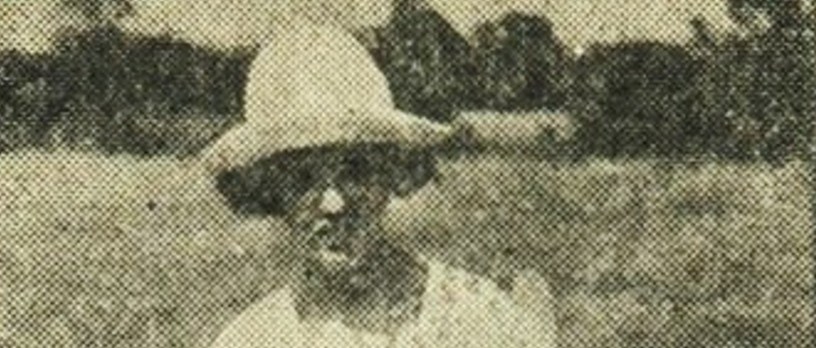
Girl cricketer? Not my term.
But that’s the phrase that’s plastered on the front of the 1924 V122 Willard Chocolate card of English cricketer Muriel Maxted.
Willard Chocolate was a Canadian company that issued a few sets of cards. One made up entirely of baseball players (V100) is rare but almost certainly more well-known than the V122 series. Williard’s other big set is V137, a series of boxers. The Willard name did not stay in the hobby for long. Those three sets were all issued in 1923 and 1924. A few additional sets were made but these are the company’s three most notable sports issues.
This set, V122, is by far the most intriguing to me. I’ve always been a little infatuated with this set, which includes a real hodgepodge of cards. If not for the expensive cards of Babe Ruth and Ty Cobb in it that, frankly, I have no interest in paying for, I’d probably try to chase the set. It’s a multi-sport series that includes pretty much everything under the sun. There’s baseball, hockey, football (Canadian), boxing, tennis, soccer, golf, wrestling, auto racing, and even basketball with the all-female Edmonton Grads team. Their card, by the way, is one of the most valuable in the entire set.
Ruth and Cobb are hardly the only big names in the set. Olympic swimmer and surfing icon Duke Kahanamoku is there, as are tennis Hall of Famers Bill Tilden and Helen Wills. There’s golfer Gene Sarazen, billiardist Willie Hoppe, and a lot more, including another Baseball Hall of Famer, Eddie Collins, who just so happens to get overlooked because of the presence of Ty and The Babe.
Plenty of notable subjects slip through the cracks, simply because there’s so much there. Maxted’s card is one of those.
Who Was Muriel Maxted?
It’s not oft-discussed and that’s likely because most people have no idea who she is. Unfortunately, finding information on her or her career isn’t easy. And while you will occasionally find traces of her in the news or on photographs, this is the only known card of her.
No woman had played professional cricket with men up to her point in time and it doesn’t seem like she did, either. There is talk scattered about her career in old newspapers. Mentions that she practiced for two hours per day. That she was training in secret with a presumably male cricketer.
But it seems that the majority of her ‘career’ was limited to playing regularly with the Beaver Cricket Club, where she was competitive with male players, even before the age of 18. She eventually became captain of that team. Later, she played for another men’s team, the Folkestone Ramblers. Here (her fame traveling to a newspaper in New Zealand), she is cited as one of the team’s first batsmen and their ‘best right-hand slow bowler.‘ There are not only reports of her playing with the teams, but being a star and in some events, dominating as a top player at times.
What we don’t have are many details of her career later on. She did keep playing, though. There are references to her in the 1930s as an outstanding cricketer. But perhaps mostly curiously, a Women’s Cricket Association did begin in the UK in 1926 but she never joined up. Interestingly, though, she did at one point lead a team against a team from that organization. The organization, which still exists today, doesn’t even have any information on her. A newsletter from a few years ago, in fact, asks for information or scorecards from her matches.
Despite the somewhat murky details of her career, Maxted was important enough to land in a set of big names of sports from around the world. And she either got an endorsement deal from Ovaltine or just really, really, really liked the product, as she said this in an advertisement for the product:
“I feel compelled to write and inform you of the great benefit I have derived from ‘Ovaltine,’
My cricket is the result of doctor’s orders to spend my life out of doors. Quite recently our doctor remarked that it is most surprising that I can stand the stress and strain of a game that makes even strong men tired, and the only explanation of this seems to be the continual use of ‘Ovaltine’ as my daily beverage.”
Much of the details of her career, as mentioned above, are found here, in what I would describe as the greatest online resource surrounding her career.
We don’t have many cards of her, but you know what we do have? Actual video footage with a precursor that calls her, “Dr. Grace (for the legendary W.G. Grace) in Petticoats.”
Muriel Maxted’s Willard Chocolate Card
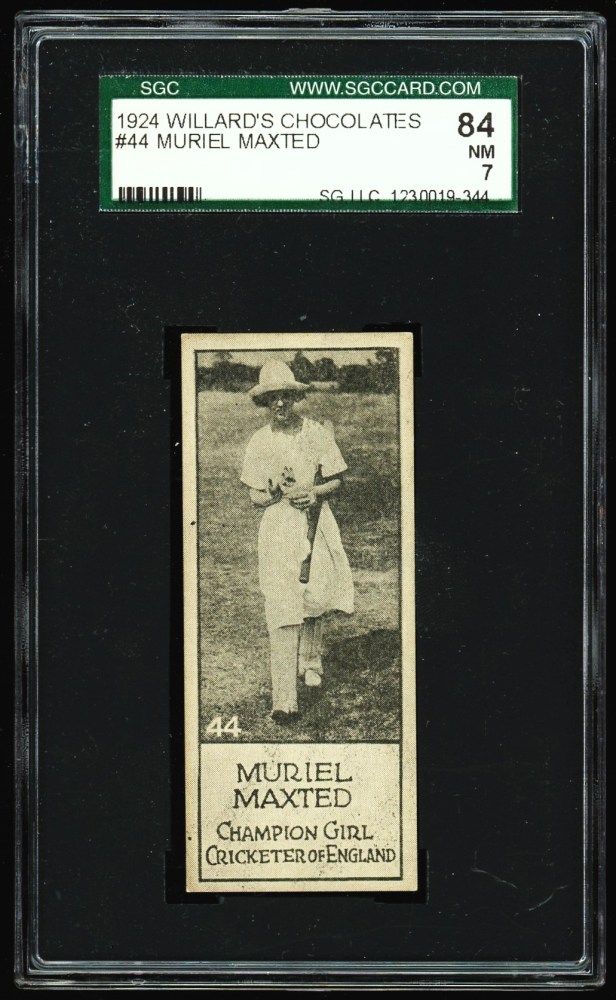 Maxted was born in 1904. That tells us that she was only 20 by the time she appeared on her Willard Chocolate card.
Maxted’s card pictures her with a bat and ball. The title calls her the ‘Champion Girl Cricketer of England’ and hers is No. 44 in the set. All cards are blank on the back so unfortunately, there’s no biography on her or her career.
What really intrigues me about Maxted’s card is something else. It is not only Maxted’s own card but I believe it may be the only singular card of a pre-war female cricket player at all. I would not be surprised to find Real Photo Postcards (RPPCs) of teams or even cabinet cards of a female with cricket attire. But Maxted’s might be the only actual trading card to picture a single female player by name.
It’s not a particularly easy card to find. Shown here is my SGC 7, which is the highest-graded by that company and only matched by two PSA 7s. The two companies have only combined to grade a total of ten Maxted cards in all, speaking to the rarity a bit. There are raw examples out in the field but those are tough finds as well.
Maxted’s card is not worth a fortune. In fact, it’s generally a common just because of the numerous other big names in the set. In raw low-grade or mid-grade condition, it is pretty affordable. In graded condition, you can expect to pay a premium. The problem is, with many rarer Canadian candy cards, you have to find one first.
Want more talk about pre-war cards? Follow me on Twitter / X here.

