 Been a while. No, I’m not dead. And yes, I’m still collecting way more than I should. But the reality is, I’ve had less time to write. Well, strike that — less time and energy to write.
But recently, I picked up a card that was worth a mention.
Chess interests me a bit. While I know how to play, I am not by any reasonable standard ‘good.’ But the game fascinates me and, like virtually anything else, I’m drawn to early cards of unique subjects.
Chess, if you’re wondering, is not something that was covered on many cards in the pre-war era. I suppose that ‘many’ is up for interpretation. However, compared to the major sports cards, you will see few of them by comparison.
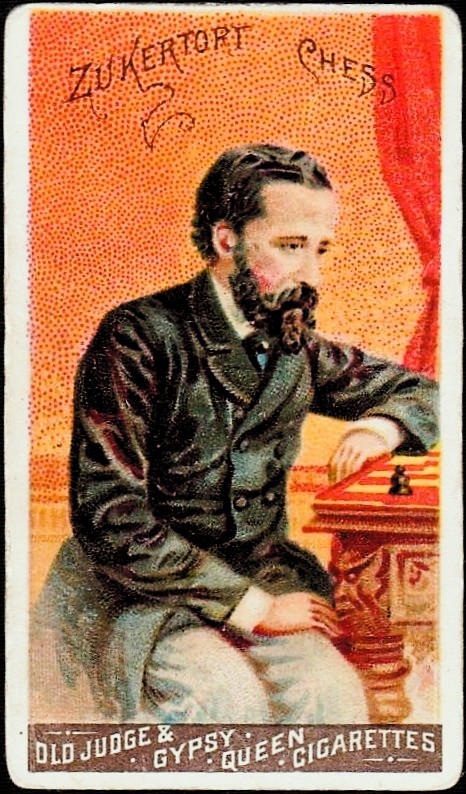
Perhaps most notably, are the cards of early chess champions in Goodwin’s popular N162 Champions set. While the four Champions sets (Allen & Ginter N28 and N29, Kimball N184, and Goodwin N162) often shared sports and even some subjects, Goodwin was the only set heady enough to include cards of chess players. Shown here is my N162 Goodwin card of Johannes Zukertort, a famous European player.
Hilariously, Kimball included many oddities in their N184 set, including a card of Clarence Freeman, the world’s checkers champion. Yet when it came to chess, a far more sophisticated game, they declined.
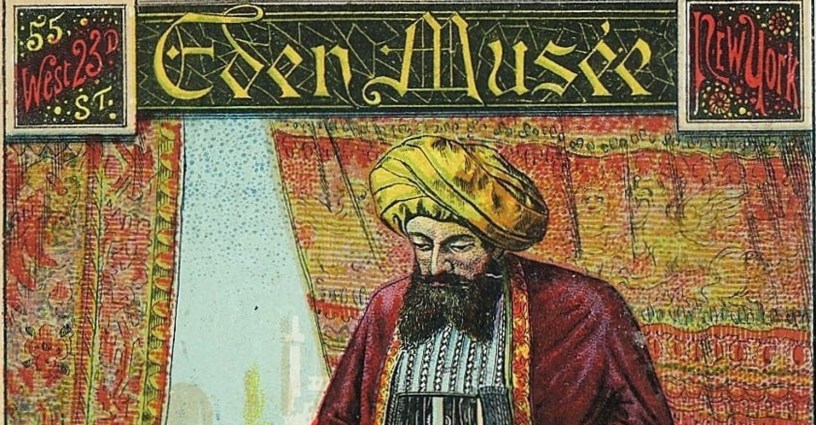
Aside from the cards for the N162 Goodwin set that I am seeking, another chess card has been on my radar — an 1886 Eden Musee card featuring Ajeeb, the chess playing automation machine. Recently, I not only secured one, but it is the highest-graded example of SGC, an SGC 4 (and bested only by a PSA 4.5 in terms of pure score from major graders).
But, what is this card exactly? Well, the card pictures a 19th century chess machine named Ajeeb.
Who is Ajeeb?
Ajeeb’s name was often supplemented by “The Famous Automation” or “The Automation Man” in advertising. Ajeeb was the name of a 19th century chess ‘machine.’ The machine was supposed to be an automated chess player (i.e. a robot) that would face off against real opponents. It was known for defeating almost all opponents.
The real scam, however, was that it wasn’t a machine at all. While advertised as an autonomous machine, it was actually staffed by players that were small enough to fit inside of it. Men that were real players. And excellent ones at that.
The machine was held inside the Eden Musée in New York — sort of a destination center, full of an assortment of shows, collections, and nonsense. Opening in 1884, this was exactly the sort of place you’d find something like this. My guess is that if Zoltar was around at the time, you would have found it there, too.
One of the best writeups on the subject of Ajeeb I have seen comes from Chess.com. Want to read more about Ajeeb and the Eden Musée? That’s an excellent place to start.
The ‘machine’ sounds far less imposing than what you might imagine. Instead of an uber sturdy framework composed of metal, Ajeeb the player was largely made of wax and papier-mâché (think piñata material). He was capable of playing both chess and checkers. I have seen conflicting reports that Ajeeb was first set up in the Eden Musée in either 1885 or 1886. 1885 seems to be the correct answer, though, as a different trade card with that copyright date advertises the chess-playing machine. It is also worth pointing out that Ajeeb only went to the Eden Musée at that time. It was said to be in operation starting in the late 1860s elsewhere.
One of the men that supposedly staffed Ajeeb was its creator — a man named Charles Edward Hooper. According to that Chess.com article, Hooper manned the machine for three years in the Eden Musée before others filled the role all the way until 1915 when Ajeeb’s service was completed.
Ajeeb’s opponents included many famous subjects. Among them were Harry Houdini, President Teddy Roosevelt, and even Baseball Hall of Famer Christy Mathewson, who pitched in New York with the Giants.
While I’ve seen many articles on Ajeeb and the Eden Musée, I’ve seen far less about the card itself. And after securing one, that’s what compelled me to take a closer look at it.
The Ajeeb Chess Automation Trade Card
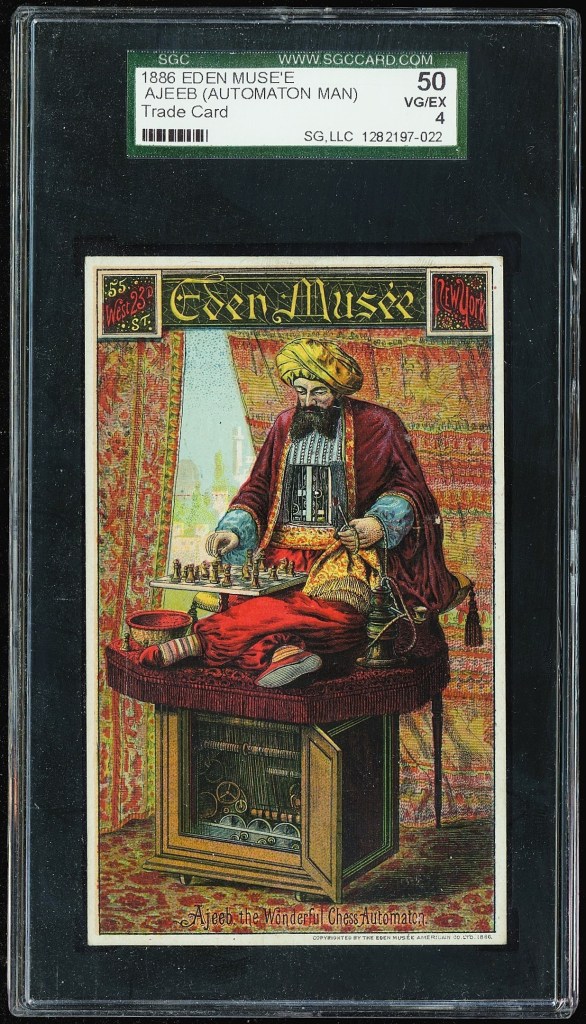 The Ajeeb card is by all indications a singular issue and not part of a set (even as other cards advertising the Eden Musée and Ajeeb exist). While collectors may know it by different names, the Eden Musée name headlines the card at the top and is usually associated with any title for it. The top mentions the facility’s address (55 West 23rd Street, New York) while the bottom bears the caption, “Ajeeb the Wonderful Chess Automation.”
The card is often referred to as a c1886 issue, likely because of the copyrighted 1886 date at the bottom. While it might be easier to simply call this an 1886 card, the ‘circa’ reference may be in place if there is suspicion that these cards were issued over several years.
The card pictures an intricate lithograph of the machine on the front. Like many other trade cards, they can be found with a series of backs.
Two are the most common and seem to be related purely to Ajeeb.
One back includes ‘Startling Facts’ about Ajeeb — even if those facts included a few lies. One, for example, states that the interior of the machine is able to be viewed by opponents, but that would have only been partially correct. The interior of the structure did show a series of mechanical parts but, certainly, the full interior was not accessible to all or the human players would have been discovered. The card also clearly stated that there was no one inside of it and that it was a fully autonomous machine. And the lie detector test determined that was a lie.
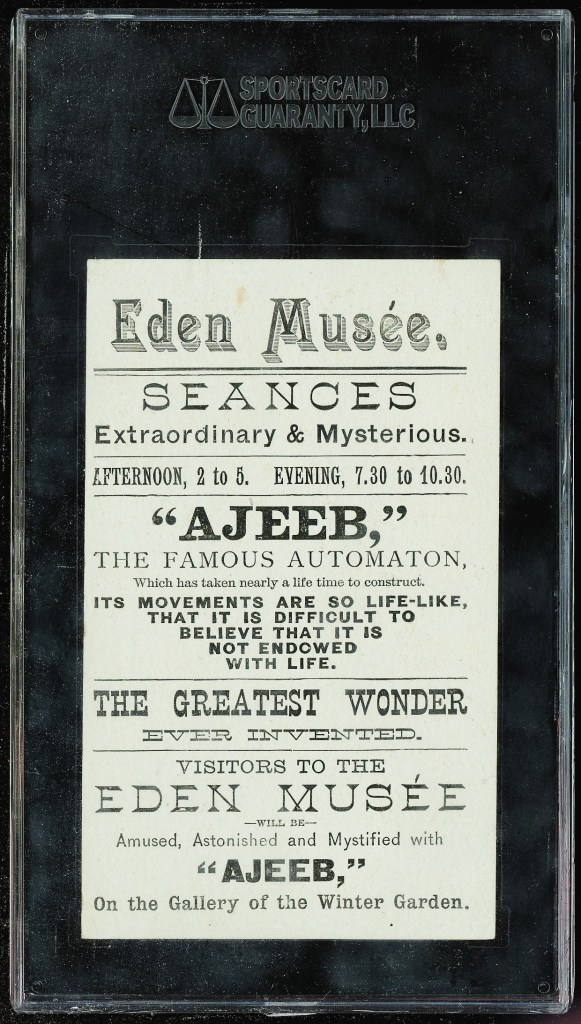 The other back is devoid of all of the facts mentioned on the other card. Instead, this one cites Ajeeb as “The Greatest Wonder Ever Invented” and that “Its movements are so life-like that it is difficult to believe that it is not endowed with life.”
Yeah.
Both backs advertise that the machine was available to the public between the hours of 2 p.m. to 5 p.m. and 7:30 p.m. to 10:30 p.m. You can see both backs here on the excellent blog of @ChessCards, an enthusiast on collecting cards of chess players.
Which is the rarer of the two backs? It is a bit difficult to say because I’ve only seen maybe a dozen of these cards so far. But the rarest of all may be ones with entirely different backs. For example, some have other advertisements (I have seen one advertising an ointment product) and others are likely blank-backed stock cards.
Because all of the cards are so rare, I am not sure what premium, if any, might exist for one of those. However, if we are technically trying to determine the rarest ones, the vast majority of these that I have seen have had one of the two Ajeeb backs. Others would seem to be significantly rarer.
There are at least a couple of other Ajeeb cards. One advertises the machine on the back while the front includes images of other things throughout the Eden Musée. Another is a wonderful cabinet card featuring a real photo of the machine. Both of those are much rarer than these cards, even if this is Ajeeb’s most popular piece of cardboard.
What can you expect to pay for one of these cards? That’s another difficult thing to determine because of the rarity since so few are bought and sold. Asking prices for raw cards, however, often fall in the $200-$400 range, even if auction sales can raise less. A raw card in decent shape sold earlier this year on eBay for about $125, but went under the radar thanks to a lack of mentioning Ajeeb in the title. As with many rare cards, the hammer price on an auction sale may vary greatly depending on who is following the bidding.
Want more talk about pre-war cards? Follow me on Twitter / X here.

