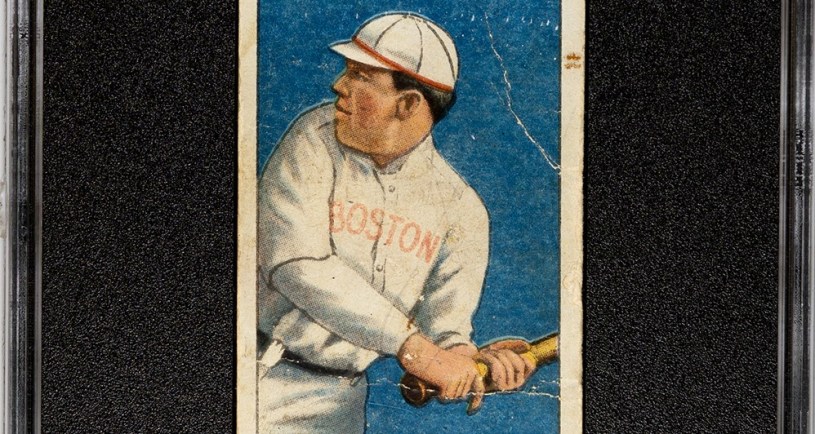
Determining rookie cards of baseball cards from the pre-war era is sometimes, clear-cut. Save for the sorts of arguments that are common, such as should things like postcards or supplements be considered rookie cards, many times, we can at least determine a player’s earliest card-like appearance.
Unfortunately, it’s not always that easy. A big problem is with players appearing in sets that spanned multiple years, like the releases that were part of the tobacco and caramel card boom that lasted roughly from 1908-1912.
 And one of those is Hall of Famer Tris Speaker.
Speaker’s credentials don’t need any propping up from me. As I wrote for an article in Beckett’s Vintage Collector a while back, his cards are not on the level of Ty Cobb, Babe Ruth, or Honus Wagner. But he arguably belongs with more than 3,500 career hits, a career .345 batting average, and an MVP award in 1912. Still, when it comes to his cards, he’s right there in that next tier of star position players, like Nap Lajoie, Zack Wheat, etc.
Trying to determine Speaker’s earliest card is not an easy proposition. For the sake of argument here, I am also leaving his oversized supplements out of the discussion.
Speaker’s first card might be a 1908 team postcard. But that issue was an appearance on a minor league issue featuring the Little Rock Travelers. We have to look elsewhere if we’re looking for his first major league card.
Speaker’s earliest major league card could be a 1908-09 Rose Company postcard — that is, if anyone could prove it actually existed.
The Rose Company postcards are a tough bunch to figure. Some have been catalogued, perhaps on assumptions, that they ‘should’ exist in theory. But Speaker’s is one that is not known enough to the hobby where even a picture of it exists in collector circles. There is a chance, too, that a Speaker postcard does exist and was simply issued beyond that 1908-09 timeframe.
Another rookie card candidate is the Novelty Cutlery postcard. That one comes from a set that is often cited as a 1907-09 release, but as is indicated in the thread here, there could be problems with that date, too, and it could be a 1910 series.
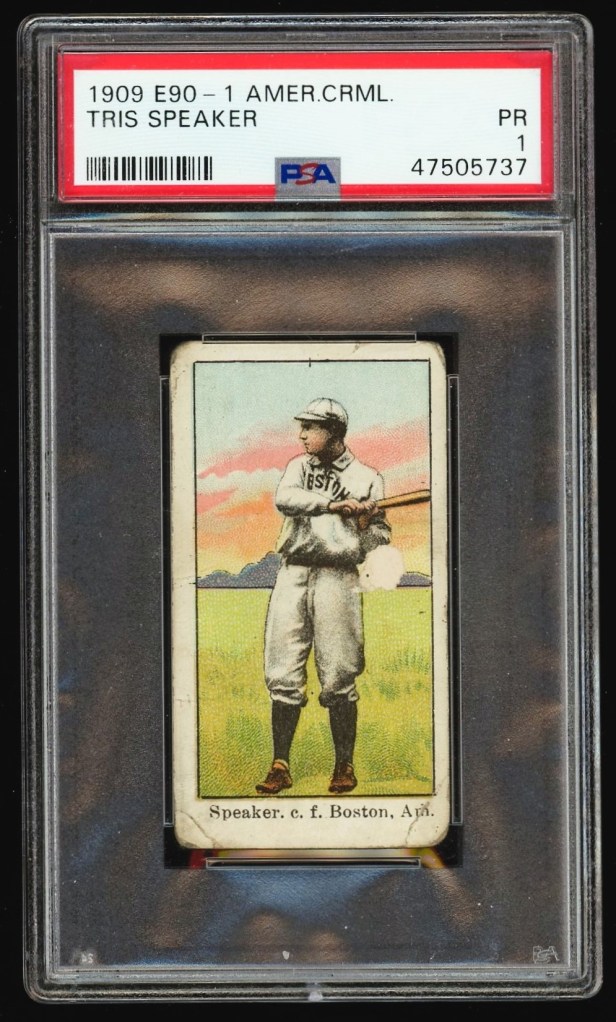
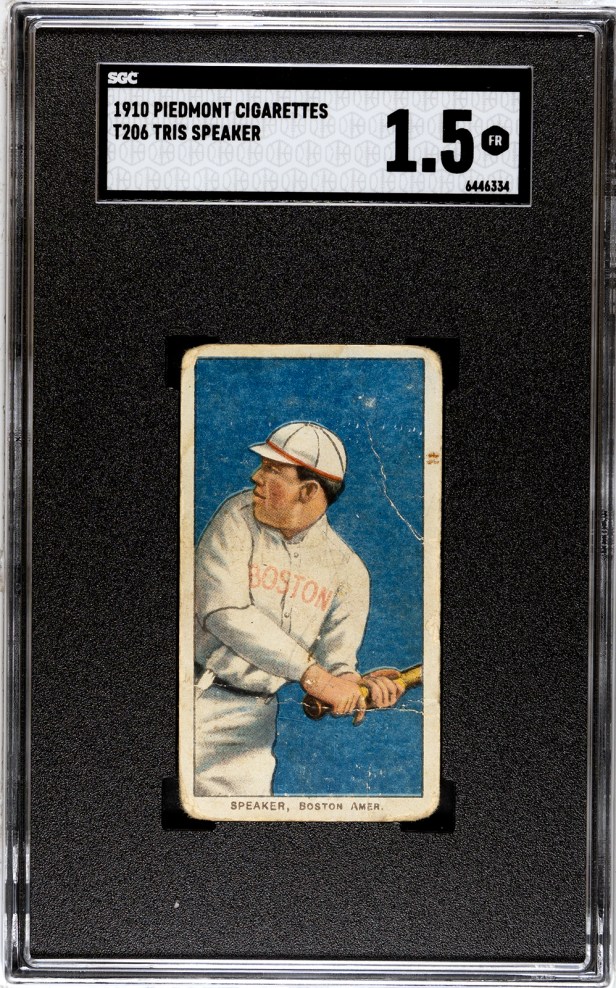
Speaker rookie card candidates are also found in the 1909-11 T206, Colgan’s Chips, and E90-1 American Caramel sets. But the problem there, too, is that the date range makes it difficult to tell when cards were printed. Speaker does not appear in any Series 150 sets, the earliest of the T206 cards that were printed in 1909. His cards, realistically, could have been printed in late 1909, 1910, or even 1911. And his shortprinted E90-1 American Caramel card, one of his most valuable, could have been printed late in the run. Similarly, there are issues in determining exactly when his Colgan’s Chips card was printed. He is a known subject in the E254 set, but that series is dated from 1909-11 with no clear indication when his card was definitely printed. Ditto for his 1909-12 Sweet Caporal Domino Disc, which clearly is not a ‘card,’ anyway.
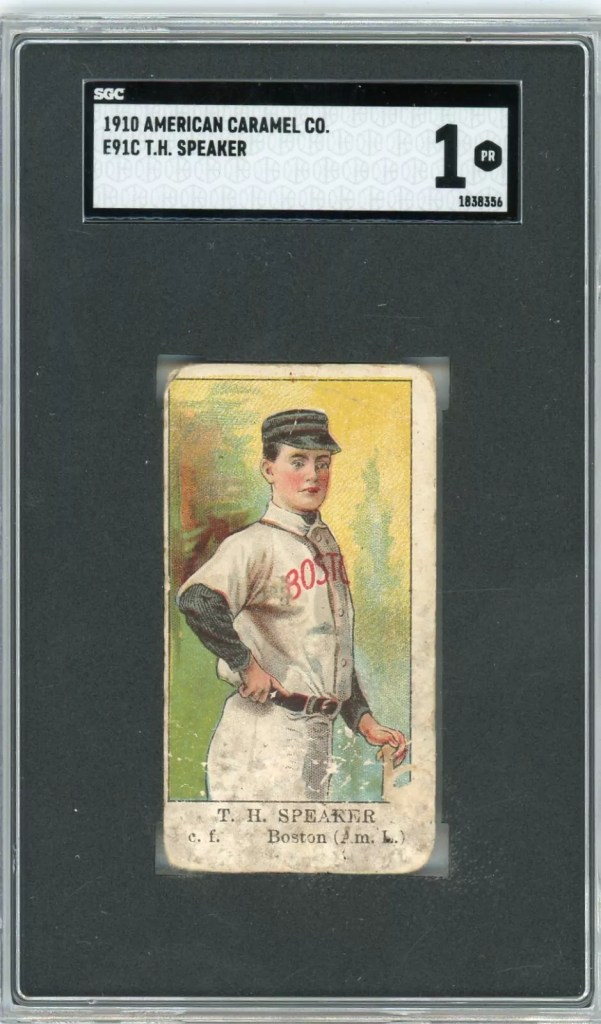 One of the only early cards of Speaker’s with a definitive date is arguably his 1910 E91C American Caramel card. While the overall E91 American Caramel series was issued from 1908-10, Speaker’s card is only found in E91C, which was printed in 1910.
While the set is not a collector favorite in that the images used were simply swapped out for different players, Speaker’s card and pose are passable. Further, as stated, we can also clearly date it to 1910.
Does that make it Speaker’s only true rookie card? No. A few other cards are cited as 1910 issues by PSA. But if 1910 is the year when we can state that Speaker’s rookie cards were issued, this would be his most common one.
In the end, though, the rookie cards of Speaker may simply be up to collector interpretation.
Want more talk about pre-war cards? Follow me on Twitter / X here.
 Pre-War Collector