While some strip cards are passable, they have the reputation of often being low-quality inferior cards. And while that’s typically okay, it’s kind of pain when a strip card is a pretty important one.
And that’s the case of Walter Hagen’s 1925-27 W512 strip card. Dubbed a set of ‘Famous People’ by Jefferson Burdick in his American Card Catalog, the W512 set is not tied to a particular issuer or creator. It’s a 50-card set of sports and non-sports subjects that was almost certainly distributed by numerous people/companies. A 50-card follow-up set, classified as W513, was created in 1928 and the sets are often considered as one big series as the W513 cards picked up with No. 51, right after the 50 cards of W512. W512s and W513s have a seamless numbering as a result from No. 1 to No. 100.
The most valuable cards in the set are typically the baseball players in W512, led by Babe Ruth and Ty Cobb. No, their cards aren’t great looking. But they are relatively unimportant mid-career cards that no one takes too seriously. They are not inexpensive, mind you. Ruth often sells for more than $1,000. But few care much about the poor artwork on them because Ruth and Cobb have a million other cards, most of which look a lot better.
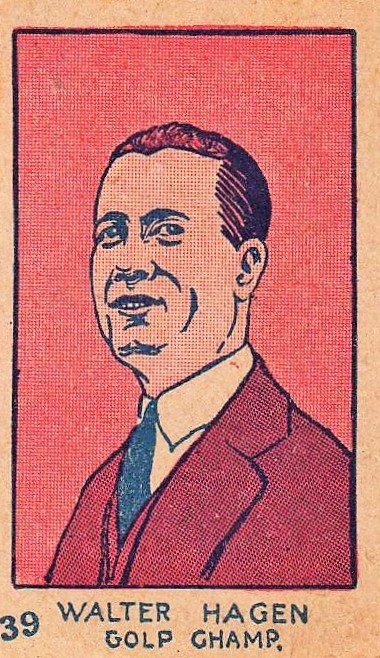
Unfortunately, in the case of Hagen, a Hall of Fame golfer, his card is a bit more important. That’s because it’s generally considered as his rookie card.
 Now, truth be told, there’s a bit of controversy with all of that. Hagen is found in a set that PSA dubs a rare 1925 series called Empreza Cinema Artistes and Sporting Celebrities. He’s also in the overly complex 1925-31 W590 Strip Card set. Those two cards are so rare that, by virtue of accessibility almost, the W512 strip cards have been given the title of rookie card, even if some of them were printed in 1926 and as late as 1927.
For the sake of the article, though, let’s not argue with the rookie designation. I want to take a closer look at the card, which is — not great.
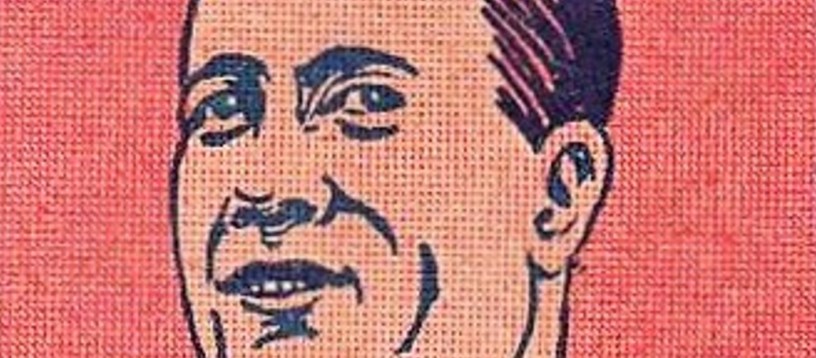
For starters, the picture of Hagen is a horrible one. Now, if you look at the picture and compare it with an actual image of Hagen, it could be worse. You can actually see a bit of resemblance to Hagen. But the set in general just has rudimentary line images that are so poorly and quickly done that it’s just not a great picture.
Once we get past that, we can critique the style of picture. Now, this is a set of portraits so expecting Hagen swinging a club would be odd. But it would be nice if the image actually featured Hagen in more suitable golf apparel. There are actually some images of Hagen swinging a club in a suit. But for the most part, he’s usually wearing a sweater or just a long-sleeved shirt, often along with a cap. This picture seems to catch Hagen in plain clothes going out to dinner than as an actual image related to him golfing.
Then, of course, we have the famous typo. Ah, yes, who among us hasn’t wanted to be a ‘GOLP’ champion?
What is most interesting here is that, the series was issued over several years. And the captions on several of the cards changed to reflect updates. Yet, I’ve never seen a correction for this embarrassing typo. I have seen some examples where the printing of the P is not quite as rigid as it is here and it can appear as if it is closer to an F. But I have not yet seen a fully corrected version. If there is, it certainly is rare. I scanned about 30 different copies of the card found online before this article and none had a correction.
In addition to the typo, the number ’39’ printed on Hagen’s card is badly askew. It’s not on just this particular card, but seemingly all of them. It might not look so serious at first glance. But if you compare it the other cards next to his on the strip, it sticks out like a sore thumb because those are all straight.
The color choices, too, seem to be poor ones. The card has, in some cases, a pink background or, in others, an orange background. Presumably, that was not so much a true variation as it was the varying amount of some ink colors during the printing process. Either of those colors would be fine if Hagen wasn’t given red hair tones (he did not have red hair) and have a red jacket. The entire card just seemingly blends together with those colors all so close.
Finally, the other thing I despise about this card is that, because it is a strip card, you often find it with torn or uneven edges. That’s a bit unfair as many strip cards share those characteristics. But the W512 cards in particular were printed in one large sheet. Often, sheets were cut into rows by printers so the top and bottom were pretty even. People or businesses distributing them could then either just cut at the sides. But it is not uncommon to see W512 cards with tears, even on all four sides, making it seem like distributors did not take great care in separating individual cards.
Despite all of this, Hagen’s card has drawn more interest with the rookie card designation. In decent shape, examples have often topped $100. But one could argue that, given Hagen’s reputation as one of the all-time greats, his rookie should command more than that. Bobby Jones’ Lambert & Butler Rookie card, which is plentiful, after all, can sell for $500 or more in even modest condition.
Want more talk about pre-war cards? Follow me on Twitter / X here.
 Pre-War Collector