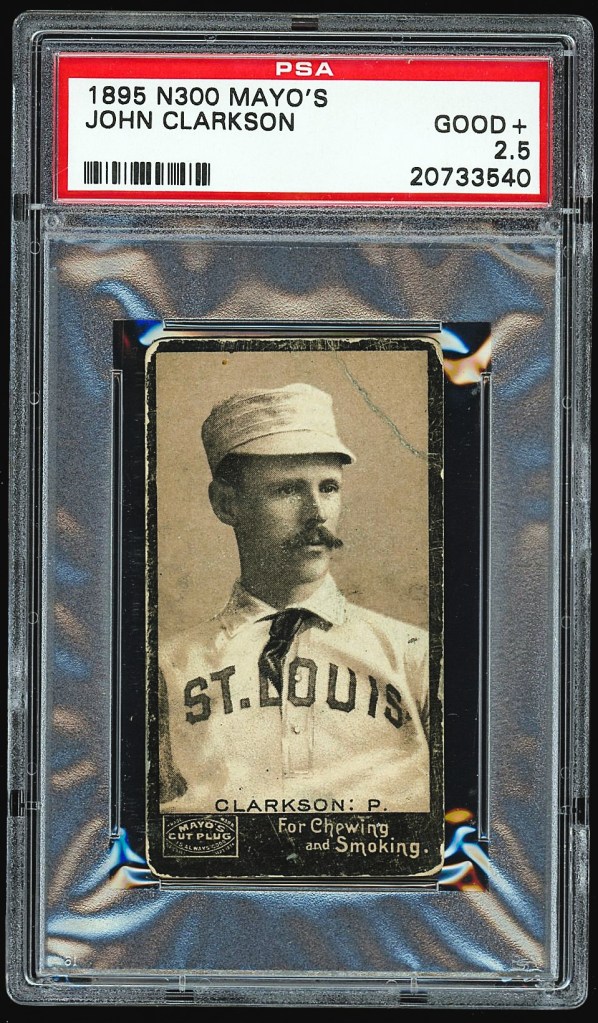
The 1894-95 Mayo baseball card set is one of my favorite releases. It’s a 19th century set that doesn’t look anything like other series’ from the 1800s.
The set has many Hall of Famers, though the card of one in particular has caused some controversy — John Clarkson.
Clarkson is well-known to 19th century collectors. Perhaps most notably, he won the pitcher’s triple crown in 1889, leading the league in wins, ERA, and strikeouts. Shockingly, his 49 victories that year were not even a career-best. In 1885 pitching in his first full season, he won an incredible major-league leading 53 games while also leading the majors in strikeouts with 308 — all while posting an ERA of 1.85, also a career-best. Clarkson arguably had his best season as a rookie (if 1885 was his true rookie season — he pitched in 14 games as a 22-year-old the year before). Had major awards, such as the Rookie of the Year, Cy Young, and even Most Valuable Player existed then, Clarkson may have swept the lot.
By 1895, Clarkson’s career was over. He was only 32 but no longer truly effective in 1894, his final season in the majors.
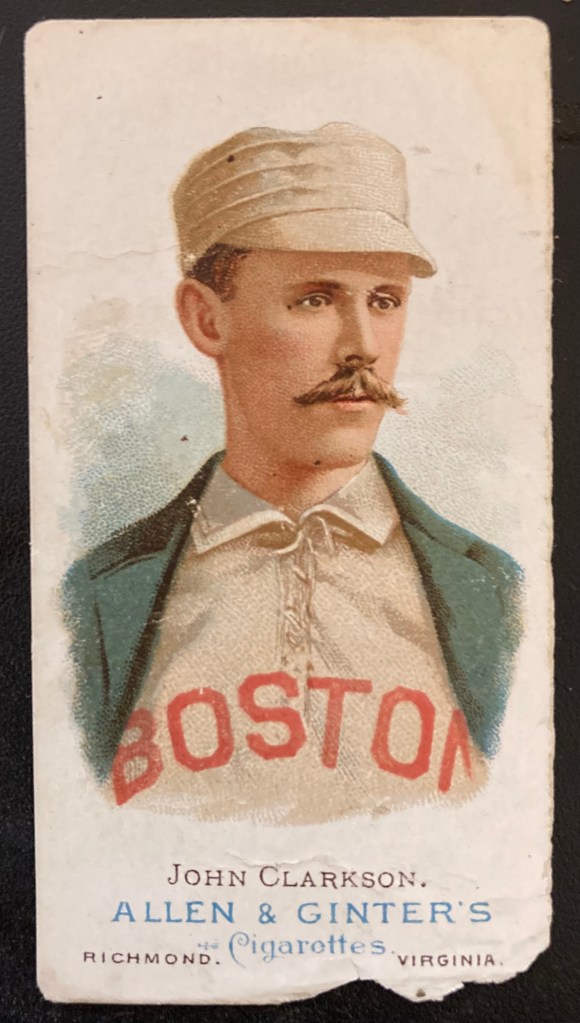
Turns out, Clarkson’s card contains an error. The image is likely him — we’ll talk about that shortly. The photo looks like the same one used to create his popular 1888 N28 Allen & Ginter card (shown here). But it’s the team designation that has confused collectors.
St. Louis?
Clarkson’s final few years were rough. Despite being in a rotation that included the great Cy Young, Clarkson failed to produce the 1-2 punch that Cleveland likely expected when acquiring him mid-season in 1892.
He was solid that year with a 17-10 record and a .255 ERA after the move. But in 1893, his ERA had ballooned to 4.45 and he was 16-17. In 1894, his final season, those numbers didn’t get much better as Clarkson compiled an ERA of 4.42 with an 8-10 record. Those losing seasons were something he hadn’t ever ‘achieved’ in a full season. That was enough to end his major league career.
Yet, it’s not Cleveland that appears on his card. Or Boston, Chicago, and Worchester, the teams he previously played for. Clarkson technically was also a brief member of Baltimore, after being traded to the Orioles in 1894. But he never reported and retired instead. This card does not feature that team’s name, either, though. Instead, the name on his jersey is St. Louis — a team for which he never appeared.
It would be one thing if his team name on the Mayo’s card was simply an older team. But how did the company manage to use a team name for a club he never played for?
There are two possibilities.
First is, the card was intended to depict someone else. Specifically, Clarkson had a brother named Arthur ‘Dad’ Clarkson that did, in fact, play (and pitch) for St. Louis from 1893-95. The other possibility is that John was intended to be the player depicted but the company simply gave him the wrong jersey.
So which is right?
Let’s Talk Dad
The Dad possibility is intriguing. I don’t know of any sets Dad is found in, though it’s possible he did make his way onto a cabinet card at some point since many players did. While a different player named Dad Clarke did appear in the massive Old Judge set, I have not seen any Dad Clarkson cards in the set. So his first ever card, if that was the case, would actually be a nice thing and a card I’d want, anyway.
Could it be a true card of Dad Clarkson? The strongest case for that is that his brother John had indeed retired after 1894 and Dad was truly a pitcher on St. Louis when the Mayo set was issued. The fatal flaw, of course, is that the picture of the player is almost certainly John.
Despite the similarity to the earlier Allen & Ginter card, there has been some question about Dad’s physical look. Could the two have been similar in appearance enough that the card could actually picture Dad?
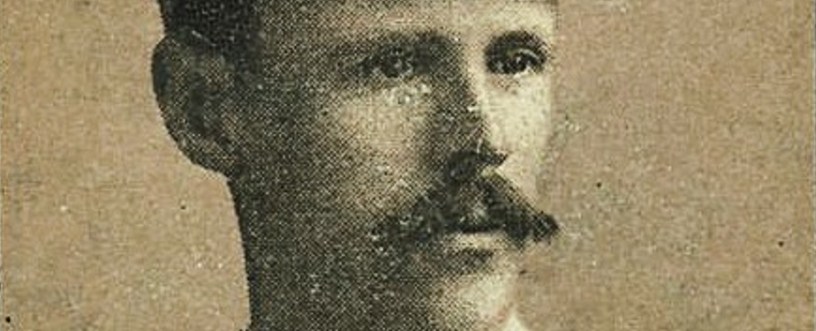
While we don’t have many pictures of Dad, I did find this one. It’s also worth noting that Baseball-Reference does have an image that looks significantly closer. Whether or not either or both of these images are truly correct isn’t something I’ve been able to uncover. But the reality is, it doesn’t even matter that much. The most important evidence we have is that the Mayo card is basically a match for the Allen & Ginter card, with the exception of the jersey.
There’s also the matter of a team change to consider when discussing Dad. In 1895, Dad switched teams, going from St. Louis to Baltimore. Mayo updated the set and several players in it received new team designations or designations indicating they had retired. While other players received an updated card, indicating their new team, Dad never did.
If the card was intended to be Dad, why wasn’t his team change covered on a card? Well, it’s possible that it came too late, depending on when Mayo decided to end production changes. Dad’s change, from what I can find, actually appeared to have come latest of all of the players that changed teams or received updated cards. Some retired after the 1894 season and Amos Rusie’s card famously was reissued after his name was initially spelled Russie on his first cards. But I don’t believe any traded player was moved later than Dad was.
But it’s close. Dad was traded to Baltimore in early June of 1895, according to Baseball-Almanac. Other team changes occurred before the season. Hall of Famer Dan Brouthers, meanwhile, did get a mid-season card change. But he was sold in May to Louisville only a month before Clarkson’s change. It is technically possible that the cutoff for production changes may have been in between Brothers going to Louisville and Dad going to Baltimore but it would have been a fairly small window for that to occur.
Let’s Talk John
I’ve got less to say about John. To me, Dad is the more intriguing subject here since he’s a virtual unknown.
The greatest evidence for this being a John Clarkson card is that, well, it almost certainly pictures John Clarkson. It is incredibly difficult to look at those two pictures of the Allen & Ginter card and the Mayo card and conclude they aren’t taken from the same photo — and that’s one of John.
Furthering the case for John is that, as mentioned earlier, he was by far the bigger star. Of course we all realize that sets are not comprised purely of star players. But in a small set like the Mayo series, which consisted of only 40 basic cards before name and team designation changes, it makes much more sense that John would have been the likely suspect for inclusion — particularly since Dad was not even one of the better players on his team. John, by comparison, was one of the all-time pitching greats at that time.
Finally, some have wondered why John would even be in the set if he retired in 1894. However, it is important to point out that other players also appeared in the set that had done the same, including Hall of Famer John Ward. Several players ended the 1894 season before retiring. However, they still made the cut for the set, perhaps because it was expected they would land somewhere.
At first glance, it may seem odd that Clarkson did not get the updated ‘retired’ card as Ward did. But if he was being mistaken for playing for his brother’s St. Louis team, then it is easier to see how that oversight occurred. Dad was still in St. Louis in 1895 and it is somewhat easy to see how the error still went uncorrected.
A Planned Career Move in St. Louis?
Some have also wondered if John was intended to join St. Louis and that is the reason for the uniform. REA even cited that possibility in a recent auction of his Mayo card. But that has always seemed far-fetched to me.
For one thing, Mayo would be taking a gamble with that decision to print the name on his uniform. For another, while you can often find rumors of players joining clubs in old newspapers, I’ve yet to come across any linking John to that team. Certainly, no rumor is widespread because it would have certainly come up in other discussions about this card.
SABR’s bio of John, too, gives us some insight into his post-Cleveland life. Clarkson apparently lived in Bay City, MI at the time, and chose to go back home after retiring. He chose to open a business (cigar store) there, and also opened up businesses in Phoenix and Chicago. There is no such mention of any ties to St. Louis and, in fact, his brother Dad actually moved to Bay City after his career ended.
Further cementing his full-time life in Bay City, in 1895, he wasn’t trying to get onto major league rosters. he was busy establishing an independent amateur team in the city. He even managed and pitched for the club, on occasion, according to that SABR bio. He barnstormed there early in his career and would have been familiar with the club, having pitched against them (including in the World Series) and with his brother on the team. But I’ve yet to see any evidence that he was going to pitch for the team in 1895.
The Verdict
A few things stick out when reviewing all of the information for John vs. Dad.
First, and most importantly, the card almost certainly pictures John. To me, that is the evidence that is hardest to shake. But there’s more.
Second, it’s important to note just how poor Dad was playing at the time of the set’s creation. Dad was not only not a standout player, he was actually the worst starting pitcher on his team in 1894 when he posted an 8-17 record and an ERA of 6.36. Now, that Browns team was a mess at 56-76-1. But they still had a pitcher over .500 in T206 subject Ted Breitenstein (27-23) and Hall of Fame slugger Roger Connor. Two other regulars, Bones Ely and George Miller, who was in Allen & Ginter’s N29 set, both batted over .300 with Miller hitting a team-best .339. If you’re only going to include one player from the club, Dad would not have been the one to choose. He would have even been the second, third, or probably even fourth choice. John, on the other hand, was a Hall of Famer and one of the most well-known players in the game.
Third, I asked myself this question: Which is more likely — that one of the most popular players in the set would be given the wrong team name or the wrong photograph? While we have seen cards with players featuring the wrong photograph, I think it’s easier to simply screw up the team name. That’s especially true in John’s case since he retired. It is very easy to imagine someone trying to determine which team he played for eyeing a major league roster, seeing a Clarkson pitching in St. Louis, and assuming that’s the guy. That mistake seems like an easier one to make than finding the picture of a retired player for a different team and assuming that image is the one needed.
My belief is that this was always intended to be a John Clarkson card. For what it’s worth, the consensus is, too, that it is a John Clarkson card as it is bought and sold at prices for a Hall of Famer instead of a common. The fact that the card seems to depict him is what has counted for collectors.
Want more talk about pre-war cards? Follow me on Twitter / X here.
 Pre-War Collector