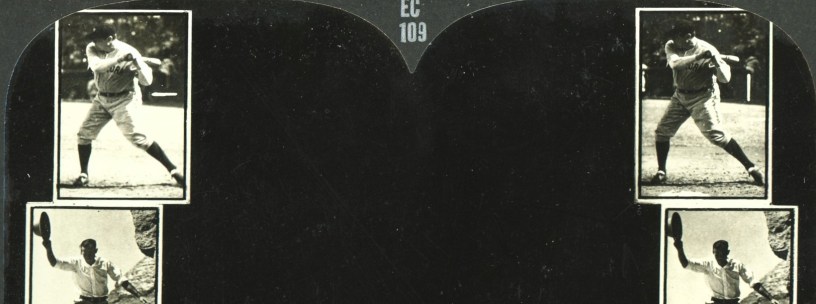
One of the most affordable playing days cards of Babe Ruth that can be found is a curious Keystone View stereoview card.
While not everyone will chase this card, it’s become a popular one in recent years as the prices of other Ruth cards have soared. The selling prices of these cards are all over the map but you can sometimes find them as little as $75-$100, even if they sometimes sell for twice that amount.
These unique cards have two, virtually-identical pictures printed on them. When looked at with a special viewer (a stereoscope), the cards display a 3D image. While not a traditional trading card, per se, they are widely collectible and a form of card, often roughly around 3″ tall by 7″ wide. While some are flat, many are curved deliberately.
Ruth is featured on several different stereoview cards but one in particular has confused collectors for years. The card was issued by Keystone View Company, one of the largest producers of these types of cards, if not the largest.
A Second Subject
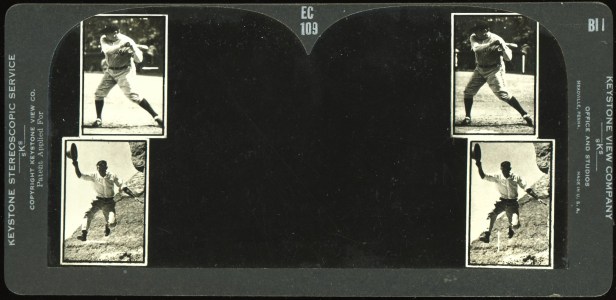 The card isn’t confusing when it comes to Ruth. While he is unnamed on the card, it is clearly an image of the Babe and that has always been widely accepted. It’s the second subject on the card that has caused a lot of head scratching.
This is a fairly unusual card as most stereoviews simply have two nearly identical images. This one has two sets of photos. One features Ruth but the other features a man jumping with a pyramid background. While Ruth is easy to identify, the other subject isn’t nearly as well known.
The second subject is often identified as Tom Mix, one of the most famous western actors of all time. Why Mix has been identified as the subject isn’t clear. Ruth and Mix can be found in some collectibles, such as an exhibit card of famous subjects. They were both very popular subjects in American culture at that time but that’s really the extent of the connection. If one looks closely, the man is holding what some have described as a cowboy hat. But it’s clearly a pith helmet, such as the one worn by Cubs pitcher Dizzy Dean here.
So if the subject isn’t Mix, who is it? The photograph actually features a photographer, George Lewis.
Lewis isn’t even clearly known beyond the community of folks that specifically collect stereoscopic cards. He’s sometimes been identified as an actor with the same name. Another famous George Lewis was actually a jazz musician. But the Lewis shown here is a photographer. And we there’s a pretty clear reason for the connection between the two.
The Proof
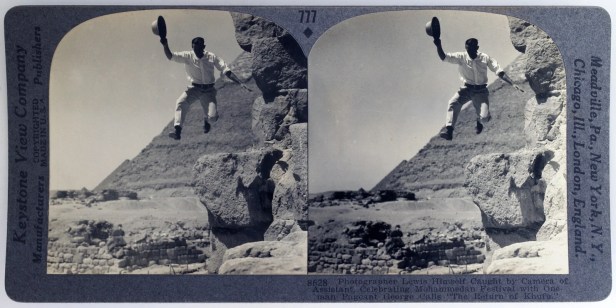 How do we know this is George Lewis the photographer? Because the same image identifying Lewis was actually used on a separate stereoview card shown here.
This separate card without Ruth shows the same image of Lewis jumping with the pyramids in the background. And critically, he is identified on the card. The title reads as follows:
“Photographer Lewis Himself Caught by Camera of Assistant, Celebrating the Mohammedan Festival with One-man Pageant George Calls, “The Return of Khufu.
Thanks to Larry, an eBay seller that specializes in stereoviews, which provided the following image for use here from his auction listing, where it’s available for purchase. Larry also added a bit of context for me in our discussion.
“The second photo is actually of Keystone’s most famous photographer George Lewis,” he says. [It] shows him jumping down off of the great pyramid at Giza in the early 1930’s and is a portion of card number 777 from their rare 1200 card Tour of the World set.”
Mystery solved. But what’s the connection between Ruth and Lewis?
The Connection
Well, I don’t know that Ruth and Lewis were actually friends. But Lewis and Ruth certainly did share a connection, even if only a professional one.
Lewis traveled internationally for his work and documented his travels. You can actually read some of them in this file, which includes some of his correspondence with the dates and locations to which he traveled.
One of those locations was the 1932 World Series where the Cubs met the Yankees. Lewis was there photographing the game and a separate stereoview of Ruth exists, which would have almost certainly been taken by Lewis himself. While the image of Ruth in the Ruth/Lewis stereoview is not the same one, Lewis would have been the likely photographer as he was Keystone’s primary photographer at the time.
While still a bit of a quirky card, Lewis and Ruth, who was photographed by Ruth, at least makes more sense than Ruth and a subject like Mix.
The Date
Yet another question collectors have had is regarding the year of issue for this stereoview. That’s a bit challenging.
The card is often listed as a 1920s card while some sellers have opted to suggest it is from the 1930s. Based on the Lewis/Ruth connection, it seems as if it is from the 1930s with the photo for Ruth possibly coming from that 1932 World Series.
But there’s another reason we can almost certainly rule out a 1920s date — that’s because Lewis did not join the Keystone View Company until August 1929.
Given the 1932 World Series appearance by Lewis, odds are that it would not have been issued before then. Further, Larry notes that the stereoview card of Lewis is part of their 1936 Tour of the World set.
One thing to note is that the aforementioned link showing Lewis’ notes includes of an image of Lewis wearing what is likely the same pith helmet on a trip in Africa in 1930. Further muddying the waters is that an image of Lewis’ showing a golfer from the top of a pyramid is dated to the 1920s. But given his debut with Keystone not coming until 1929, again, this appears to be a 1930s issue. It is possibly from as early as 1932 but as late as Larry suggests, 1936.
Collectors should also be aware there are different types of the cards with different backings, etc. It is possible that these cards were printed over several years, even if it is unclear, which cards may have been printed earliest, etc.
The TLDR here is that this is certainly more likely to be a 1930s card than one from the 1920s.
Want more talk about pre-war cards? Follow me on Twitter / X here.
 Pre-War Collector