
Anyone who’s been following the rise of non-sports cards in the past few years can tell you that it’s not just cards of famous people that are selling well. While cards of U.S. Presidents or other famous people are generally the ones that can sell for big money, cards of landmarks are gaining notoriety, too.
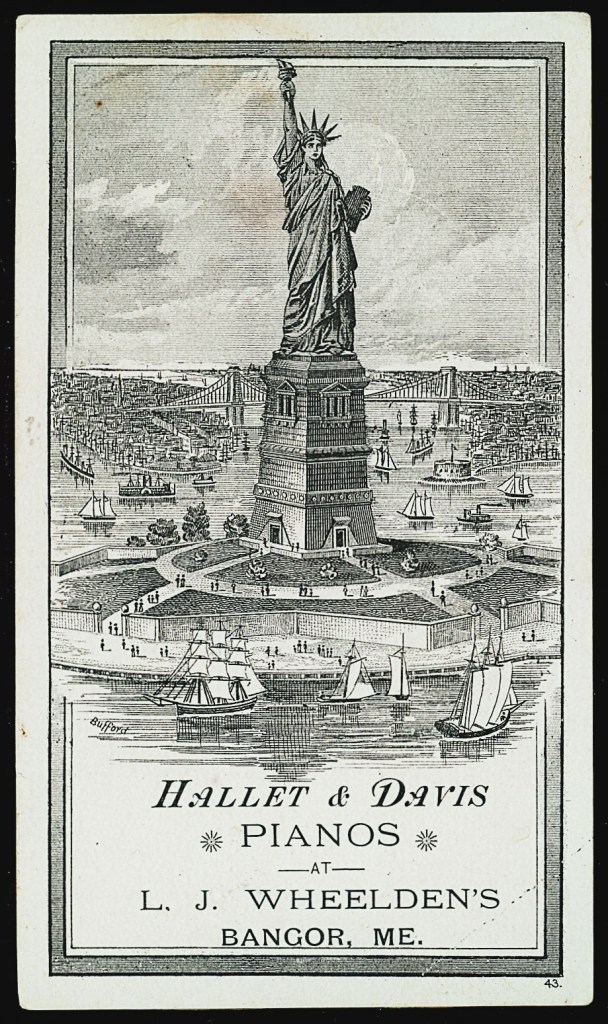 Among the more famous of the landmark cards are the ones focused around the Statue of Liberty.
It is commonly mentioned that the statue was a gift from the French. While that is technically true, both France and the United States paid for parts of its construction. Work began on it in the mid-1870s and the statue was completed in 1886.
But more importantly to the discussion here, numerous trade cards advertising the statue’s coming were issued prior to its construction. Shown here is one advertising Hallet and Davis Pianos.
Historically, there have been so many of these trade cards available featuring the landmark that they were often quite inexpensive. It was not difficult to find them a few years ago for as little as $5-$10. Today, even in low-grade condition, the cheaper cards generally start around $25-$50 with nicer ones selling for $100 or more.
While many of these trade cards are desirable, the one that seems to have garnered the most attention is an oversized card copyrighted in 1883 by Root & Tinker. The card was one of many advertising the statue’s coming and, perhaps importantly, they state that they are the only authorized edition’ of cards that were produced. That phrase was likely added as many other cards advertising the statue were being created, too. According to this post on the Library of Congress page, Root & Tinker registered their lithography of a rendition of the statue with funds raised from its use perhaps going to the U.S. portion of funding, which was supposed to cover the base/pedestal.
The 1883 Root and Tinker Statue of Liberty Cards
So what’s with these Root & Tinker cards?
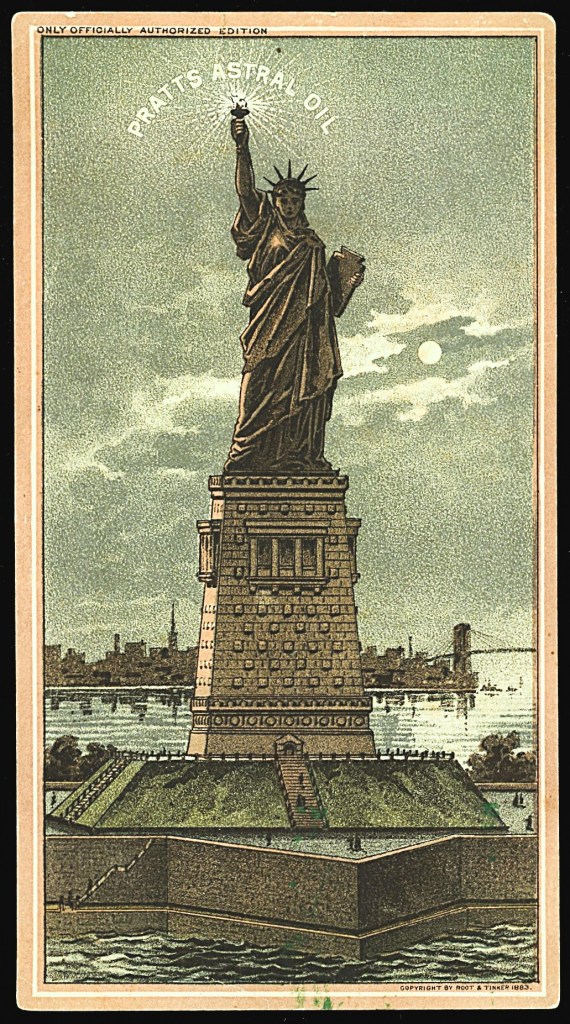 The size/shape of the cards definitely stands out a bit. At roughly 3 1/4″ wide by 6″ tall, they are roughly the size of a slightly elongated postcard. The front includes a lithographic rendition of what the statue would look like upon completion and the 1883 Root & Tinker copyright. The back includes a writeup of the planning for the statue along with its original intended name – Liberty Enlightening the World.
Some of the backs call the structure, “The Great Statue” while others call it “The Bartholdi Statue” as it was designed by Frederic Auguste Bartholdi. And keeping in line with their claim of being the only authorized trade cards for the statue, some (if not all) of the cards mention that the image on the front is ‘not a fancy sketch, but an accurate representation of the Statue and its Pedestal.” That is seemingly directed to other advertising cards for the statue, which they would deem as not truly accurate depictions.
Several different variations of the cards can be found as they were issued with different advertising sponsor names. Pratt’s Astral Oil and The Singer Manufacturing Company are perhaps the two most common company names printed on these.
It can be difficult to find the cards. That is because, like many 19th century trade cards, they are sometimes referred to as the advertisers mentioned on them instead of the more appropriate Root & Tinker name. However some other names are seen on them as well.
Variants
At least one completely different variant of the card is known, too. These cards have a red border and call this “The Bartholdi Statue” on the front along with presenting a slightly different image. The examples of these red-bordered cards that I have seen have been blank and appear to be printed on thicker stock. However, I cannot say if that is the case with all of them.
Root and Tinker also issued larger lithographs of the statue beyond these smaller advertising cards. The posters are roughly two feet by three feet and include a similar image of the statue on white stock. These larger posters are much more valuable than the cards and can sell for $2,000-$3,000 or more.
Finally, it is important to note that, as Root & Tinker copyrighted the image, they would have conceivably wanted to get as much use out of it as they could. It can certainly be found on other paper products or even other cards not mentioned here.
The First Statue of Liberty Card?
Are the Root and Tinker cards the first depicting the statue?
Well, there are earlier items depicting the statue. Earlier lithograph depictions are known and there are some stereoscopic cards picturing the torch’s construction (the statue was constructed in pieces rather than all at once) have an 1876 date on them. But most of the trade cards out there do not include a specific date and is impossible to determine when specific ones were created.
In terms of actual trading cards, I have not seen Statue of Liberty trading cards with an earlier date printed on them. The Root and Tinker cards, too, for whatever it is worth, are the ones most commonly cited as the earliest.
Further, these appear to be the earliest cards in the databases of major grading companies PSA and SGC.
Thanks to the uncertainty surrounding dates of 19th century trade cards, it may not be possible to ever truly know the date of the first Statue of Liberty trading card. But the 1883 Root and Tinker seems to hold that distinction for now.
Condition Traits, Rarity, Value
I have not seen many of these cards in very good condition. I have not seen any in high-grade condition or maybe even mid-grade. SGC, which grades these, hasn’t either — the highest grade one has received from them is a 1.5. While many look good on the surface, toning on the back, back damage, minor creasing, and corner/edge wear are all common damage that is commonly spotted at close range. Further, the borders are gold colored, perhaps to mimic the statue’s original bronze color. That darker type of border easily shows even minor edge wear.
In terms of rarity, the cards are not exactly scarce. However, with only five graded copies by SGC to date (I do not see any graded by PSA), you will not find them in every card shop or show — even if most copies are raw and ungraded. eBay usually has a handful available for sale, but it is a somewhat rare card.
Prices for the cards are all over the place. An SGC 1 sold in an auction for nearly $650 last year but most that have sold since then have been for significantly lower. Right now, the card is typically in the $150-$300 range, depending on condition. Ones in nicer condition would certainly fetch more — particularly one that has been professionally-graded as such. But as stated earlier, those seem to be extremely rare.
 Pre-War Collector