Yikes, it’s been nearly two months since I’ve written anything. Time flies.
So I’d first seen this 19th century carte de viste (CDV) featuring Civil War officers a few years back when I purchased one. Recently I had the chance to buy an upgraded version and figured now was as good a time as any to write about these unique cards.
A CDV is essentially a small photograph that’s been mounted onto a cardboard backing. Some are affixed to plain backing without any details while others are mounted onto a backing that includes the name of the subject, and/or an advertisement for a photography studio, etc.
Even though most CDVs are from the 19th century, you’ll still find them all over the place in somewhat plentiful numbers. Sure, your local card shop stocking modern Topps or Panini cards isn’t likely to have them. But you can find CDVs (even collections of them) on eBay without much trouble.
The thing to know about these is that many families simply had them made, even if they weren’t necessarily famous subjects. They were basically family photographs in those cases and the vast majority of subjects are not of anyone special. The CDVs that are generally worth the most, of course, are of famous subjects.
Even expecting CDVs of all famous subjects is a bit of a reach. That’s because some, like George Washington, for example, were produced in large numbers because they were so popular. The CDVs that are often worth the most are the ones of famous athletes or subjects that have relatively few examples known. Thus, trying to figure out an exact value of most of them is quite difficult.
Another factor in the value of CDVs is the mounting. Ones that have the name of a photography studio on them or other identifying print are generally more valuable than when then mounted cardboard is completely blank.
They are quite popular over the larger cabinet cards because these are generally a bit more card-sized. Usually, these are less than the size of a 3″ x 5″ index card.
This one in particular caught my eye.
The Civil War CDV
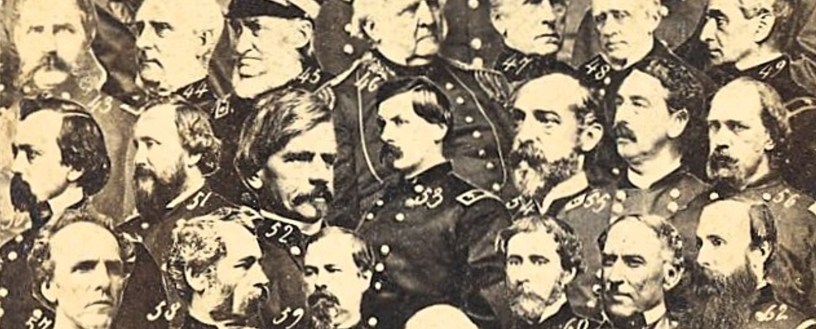
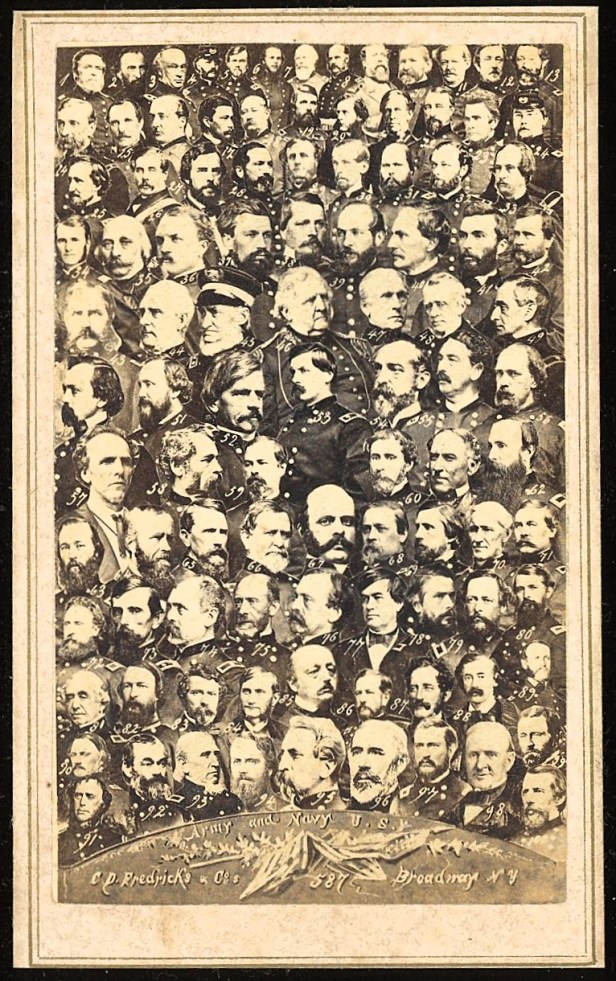 This CDV features headshots of 100 U.S. Army and Navy officers, including admirals, generals, commanders, and lieutenants. All of those men were quite important, of course. But almost all are names that are forgotten to time. The card measures roughly 2 1/2″ wide by 4″ tall, making it a nice-sized card that can fit in standard semi-rigid toploaders.
It is often referred to as a Civil War CDV, even if that name doesn’t actually appear on it. What is on it is print at the bottom of the photo on the front, noting that these men are representatives of the U.S. Army and Navy. These were members of those military factions during the Civil War.
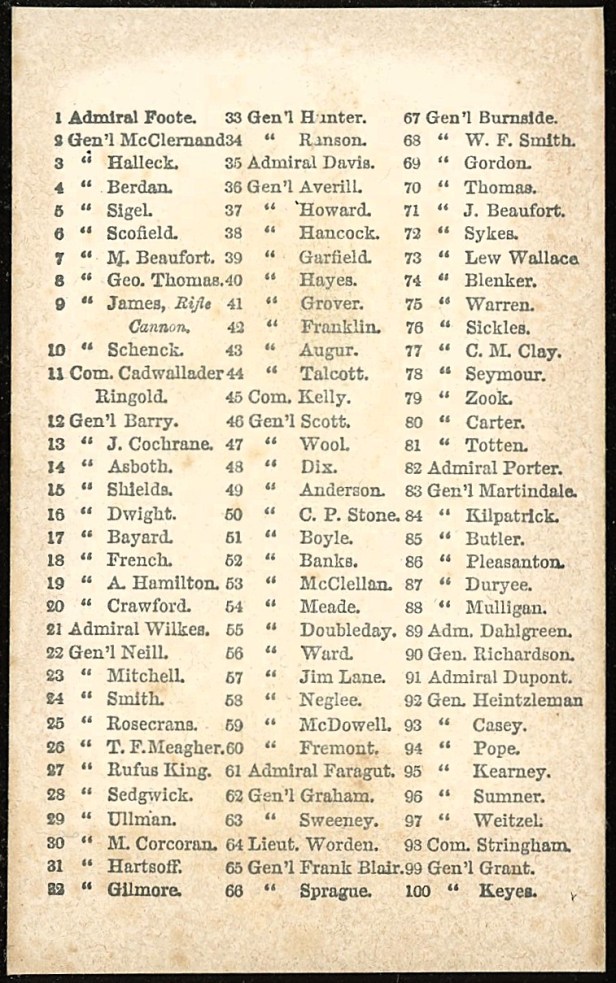
Hardly anyone will be able to identify more than a few of the men on the front solely by their picture. But the good news is that the back helps identify all of the subjects. That’s because it serves as a checklist with literally the names of all 100 subjects identified on it with a small number printed on or next to their faces on the front.
 Two big names are found in the collage. One is Ulysses Grant, who went on to become President in 1869. Before that, Grant was a general of the Union Army in the Civil War and that’s how he’s depicted on this card in full uniform.
More notably for collectors of sports cards, the other famous subject on the card is Abner Doubleday, who was a General. Doubleday was famously regarded as baseball’s founder once upon a time. While he is still often referred to by that title, the idea of Doubleday actually inventing the sport has been regarded as a myth by many.
Despite that, interest in Doubleday items remains high, certainly to some degree because no one inventor of the sport is widely credited. To many, the game is merely an evolution of other forms for ball and stick/bat games that preceded it. Thus, there are still many that collect Doubleday items.
Larger cabinet photos of Doubleday can sell for hundreds of dollars. As a point of comparison, cabinet photos of non-important subjects can be bought for as little as a few dollars.
Doubleday is No. 55 on the front and is found six rows down and is next to last in his row. Grant is even easier to spot at No. 99. He’s all the way down at the bottom, pictured at the right border just above the final subject that is in the lower right corner.
While there are many different cabinet cards and CDVs of Doubleday, this particular one was issued by C.D. Fredericks and Co., which was based on Broadway in New York. The Fredericks name is on many other CDVs in the same time period. Fredericks actually offered a cabinet of Edward Payson Weston, the famous pedestrian (professional walker) that is sought after and dated to 1867.
As far as the dating of this particular CDV, a specific year is not printed on any I’ve seen. But given the nature of the CDV as a Civil War-era item, it’s usually considered to be from the 1860s.
Want more talk about pre-war cards? Follow me on Twitter / X here.
 Pre-War Collector