
There aren’t too many players with the name Anson in baseball history but it’s a subject that’s intrigued me, given, well, that’s my name. The lack of players named Anson is especially true when it comes to major leaguers. In fact, no players were given Anson as a first name and the most famous Anson, of course, is Hall of Famer Adrian (Cap) Anson.
‘Ansons’ are a bit more prevalent in the minor leagues, though not common by any means. According to Baseball Reference, three such players have bore that name. One, Anson Jones, who lasted a single season in the minors at the age of 19 in the 1984 season, was not a pre-war player. Anson Cole played parts of two minor league seasons in 1912 and 1914, but I am not sure if he has any trading cards. I have never seen one.
There’s only one player that I have found with the first name of Anson that has any known cards — Anson Mott.
Sound familiar? Unless you’re an advanced collector of the T212 Obak minor league cards, probably not.
Mott never reached the major leagues but had a pretty decent career, lasting seven seasons in the minor leagues, primarily in the south and the northwest. He played about half of his career in the famed Pacific Coast League, suiting up in Seattle, Portland, and Vernon.
Like many minor leaguers in that era, his stats are incomplete. But what we can tell is that Mott was not a star — at least offensively. He hit a strong .284 in 1905, splitting his time between two teams. But his offensive numbers seemed to taper off after that. And he never got enough of a positive look to warrant a callup to the Big Leagues.
Unfortunately, the majority of Mott’s career came just at the start of the 20th century tobacco card boom for baseball cards. And because he never reached the major leagues, he isn’t found in most sets. But he does have two cards in the 1909-11 T212 Obak sets. One is in the first Obak series from 1909 while the second is from the more common 1910 issue.
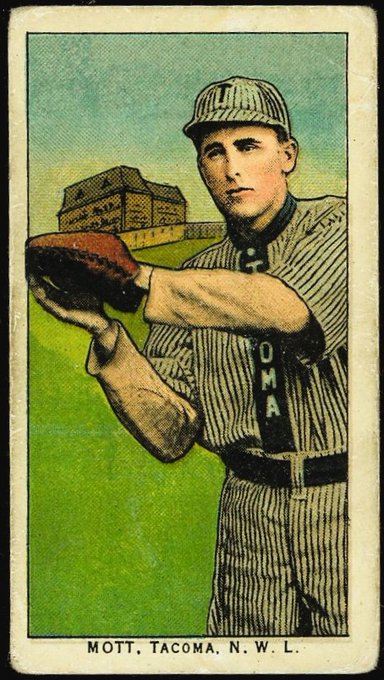
The T212 Obaks, if you are unfamiliar with them, are one of the storied minor leagues series of the pre-war era. Issued in 1909-11, the three sets have a grand total of 426 cards and, due to their rarity, completing any of the three is difficult, let alone all three. It’s a task I’d love to try, particularly because I have the ‘Big Three’ cards in the set already — Buck Weaver, Chick Gandil, and Ten Million.
But even if I could stop sidequesting entirely and building a set became my sole focus, I feel it would drive me nuts. And while the cards feature primarily unheard of players, they have gotten quite expensive over the years. A while ago, lower-grade cards could be found starting around $10-$15. That price has practically tripled these days.
I’m not sure what has suddenly drawn collectors to pursue cards of minor league players they’ve never heard of. I know some folks are collecting specific teams. But I’ve been surprised at how much these cards are fetching. They are, undoubtedly, rarer than T205 and T206 cards, of course. But for the same price, cards of bonafide major leaguers from those popular sets can be bought.
In 1909, Mott is pictured with his Vernon uniform. I’d been looking for his cards but they simply didn’t appear for sale — at least at the price I wanted to pay. I found this one at a much-more-reasonable, though not inexpensive, $50.
The 1910 card shown here is the one I recently picked up, where he’s pictured with Tacoma in the Northwest League. That was his last year of professional baseball when he batted only .233 as a 28-year-old.
Those familiar with Obak cards might wonder if he’s found in the larger 5″ x 7″ T4 Obak Cabinets series. Those cards could be requested by collectors with a redemption offer involving coupons. But despite the fact there were 175 players, Anson was not one of them. That is because those cabinet cards were issued in 1911, the year after his career ended. To my knowledge, Mott’s only cards are in the T212 Obaks.
I’d love to track down the other Mott Obak card. Unfortunately, all Obaks are somewhat rare and the inaugural series from 1909 where his other card is found is the toughest of the three sets.
But it’s out there. PSA has only graded eight of them in all but the majority out there will be ungraded. Fortunately for me, his is not generally an expensive card. The hunt will be in finding one for sale.
Want more talk about pre-war cards? Follow me on Twitter / X here.
 Pre-War Collector