
By most accounts, the legendary Charlie Chaplin was not only a famous comedian, he was one of the most famous people in the world. Chaplin’s famous career lasted nearly 80 years and is well documented. His career began as a young child, he came to the U.S. shortly after entering adulthood, and he subsequently appeared in numerous films while also overseeing music compositions for those movies at the same time.
As a famous entertainer, Chaplin appears in many card sets from the 1920s and 1930s. The prime of his career coincided almost perfectly with the rise of tobacco cards in Europe, even though such cards here in America were being replaced by cards from candy and gum manufacturers. Add it all up and you will find Chaplin in all kinds of cards, mostly international cigarette/tobacco ones, in those two decades. He’s also found in several strip card sets, which were rampant in the 1920s.
Many of Chaplin’s cards may surprise you if you’ve never encountered one. That’s because he is often pictured without his traditional look, including a small hat and mustache.
Collectors flocking to non-sports cards have been asking the question about Chaplin’s very first card. As with many, it’s not an easy one to answer. There are three fairly well-known types of cards that are considered by most to be his earliest issues.
Before I dive right into them, however, it is notable to add that it has always been difficult to track rare international issues. While that is true for sports cards it is even more true for non-sports cards, which have not been catalogued nearly as effectively. And of that subset, it is even harder to track cards not based in the UK. It is quite possible for other early Chaplins to exist.
These three, though, are the ‘standards’, so to speak.
Charlie Chaplin 1916- Movie Souvenir/Moriarty Playing Cards
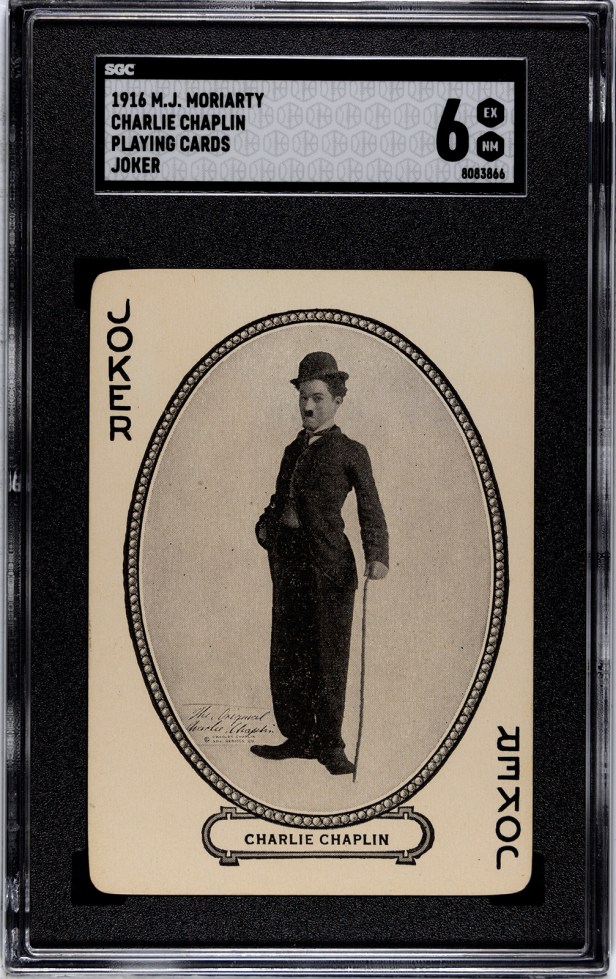
While opinions may vary on Chaplin’s first cards, his card in the Moriarty Playing Cards set has most commonly earned that moniker. The official name of the game is the “Movie Souvenir Playing Cards” set, a creation from the U.S. Playing Card Co. and the Movie Souvenir Card Co., both based in Cincinnati, Ohio. The U.S. Playing Card Co. was originally the Cincinnati Game Co. until a name change.
You’re more likely to see it called the Moriarty Playing Cards set, though, even if that’s not the proper name. The Moriarty name comes from the M.J. Moriarty copyright name on the front of the boxes.
Chaplin’s card is notorious for being the Joker in the deck that features images of actors and actresses. I expect it holds the first card for numerous subjects, including famous Wild West star Tom Mix.
I’ve had several examples of the Chaplin card in my collection for some time. And while the deck does date back to 1916, the problem is that it was one that was seemingly printed for a few years after that. The reason, most likely, was to include cards of new actors and actresses, as the subjects did certainly change. Some decks include different cards but there were many constants that were seemingly in all of them, including Chaplin’s Joker card.
Unfortunately, I am not aware of any way to definitively determine which of Chaplin’s cards are from 1916 and which are from other years. This page has painstakingly tried to capture all of the card variations in the different decks.
It is worth noting that, while there are different variations of decks, I have not yet seen any definitive proof of which years they were issued in. This thread refers to Dorothy Dalton’s card, which includes a signature with a 1919 date. That would, of course, mean they were issued until at least 1919. But I’ve never seen any specific end point for production with most sources settling on ‘around 1920.’
Prices on these vary quite a bit but low-grade examples typically start around $50-$75.
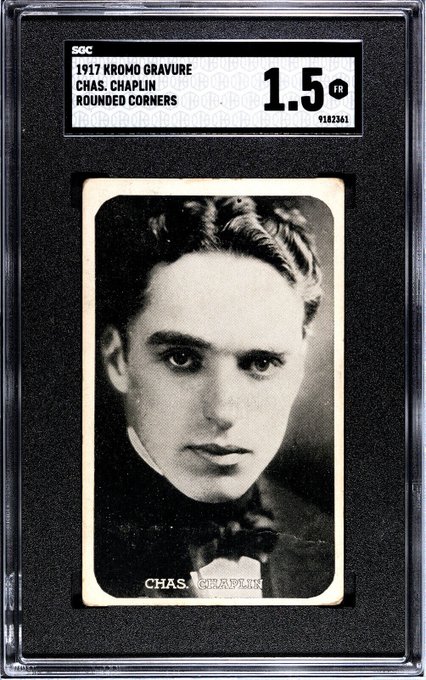
Charlie Chaplin 1917 Kromo Gravure
Of the cards posted here, the rarest are Chaplin’s 1917 Kromo Gravure cards. There were three different sets of these — one with subjects inside of a rounded border (as shown here), one with a square border, and a third with a full bleed/no border.
These were issued by the Kromo Gravure Photo Company in Detroit and boxed in small packages of 50. I am unsure if there was a different method of distribution but that is the only one I have seen to date.
While these are recognized solely as 1917 cards, some collectors say they suffer a similar fate as the Moriartys and were issued over a span of a few years. And like the Moriarty cards, that range seems to fluctuate with differing opinions. I’ve seen references to them as 1917 cards, 1917-20, 1917-21, or even simply 1910s.
These are generally the most expensive of the cards discussed here, starting around $100-$200 in low-grade condition.
Charlie Chaplin Postcards
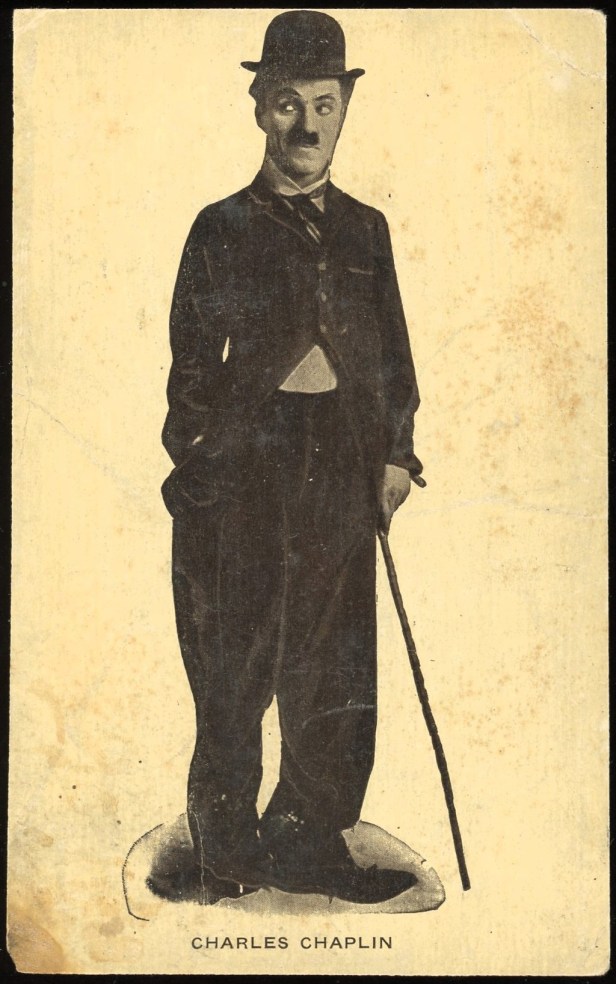 Charlie Chaplin’s postcards are perhaps the most complex of all.
Chaplin became an Essanay Studios actor in 1915 and they issued at least two sets of postcards. One is called the “Red Letter Postcards.” The other is untitled, but bears the Essanay Film Mfg. Co. name and their logo. I have seen both of these sets referenced as 1915 issues but also some that state they were printed after that. By 1918, though, he had left Essanay and began working with Mutual and First National. So while I have seen some reference these postcards as 1920s issues, that does not seem likely.
And while Chaplin is on a number of other early postcards, there are a couple of important ones to mention. One, shown here, was issued by Kraus Mfg. in New York. A second was a set from Cobb-Shinn with cartoon depictions. I call out these two types specifically because I have actually seen some (like the one shown here) bearing a 1915 postmark date, ensuring us that at least some were issued by that date.
Despite the fact that some, or even all, of these postcards were issued prior to 1916, they are generally the least sought after examples. Low-grade postcards from any of these three sets start around $5-$10.
Why are these postcards so unpopular? Part of the reason is there are dozens of them. That does not even tackle the question if a postcard should be a subject’s legitimate first card/rookie card. To me, though, it’s that former question that is the problem. If there was simply one early postcard of Chaplin from 1915, it would carry much more weight. MovieCard has identified at least 29 different ones. With that many in production and seeing that it is not a rare issue, prices on them are quite low.
Want more talk about pre-war cards? Follow me on Twitter / X here.
 Pre-War Collector