Pre-war cards, today, are defined loosely as those cards that originated prior to (or, to some, through) World War II. But the definition used to mean something different and previously referred to those cards prior to World War I.
While the W545 strip cards aren’t one of those sets, they are one of the earliest cards that were created as a reference to the first World War, fought from 1914 into late 1918.
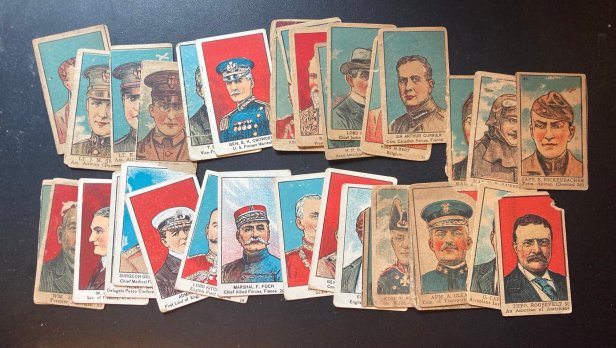 The set is most known for that reference, of course. But to those that collect it, it is known for being a frustratingly difficult set to build for two reasons. First, the cards are not all that common. And even when they are found, they are often miscategorized by sellers unfamiliar with them. They have no maker/printer name on them or even the name of an advertiser or set.
As a strip card, that is not uncommon, of course. Most strip cards are these sorts of anonymous, low-grade types of cards that were sold inexpensively or, in some cases, even given away by merchants. But most baseball cards are at least recognized and are somewhat well-known by early collectors. This set with less of a following is not nearly as well-known as common baseball issues, like W514, W515, etc.
The second thing that makes this set very hard to complete is its size. Many strip card sets are complete with ten cards (often issued in strips of ten). Others, particularly the more popular baseball ones, have more. The W514 set, issued in or around 1920-21, is considered the ‘granddaddy’ of strip card series’ because of its large size at 120 cards. The W545 set has a grand total of 200. There may be larger strip card sets but I am not aware of them. Certainly, none come to mind at the moment.
This is a set I’ve been building for about 2 1/2 years now. I am 90% complete on it, possessing about 180 of the 200 cards. I cannot imagine there are too many complete sets, in part because of the difficulty, and in part because few probably have much interest in it.
Mysteries
By all indications, these have been regarded as having been actually printed after the war ended. If assigned a date at all, they are often simply called a 1920s issue. That is perhaps because most strip cards date to that decade.
It is tempting to try to date the cards based on the subjects included. For example, Woodrow Wilson was U.S. President at the time and he is pictured and titled as such. He was in office until 1921 and it could be that this set was issued prior to his exit, making it no later than a 1921 set. However, it is important to remember that these were presumably personnel carrying their respective titles during the war — not particularly titles they held at the time the set was actually printed.
There also are not cards hailing the end of the war, like you might suspect. That has always made me wonder about the print date. But the big takeaway here is that I am not aware of any definitive date of issue for these cards.
The manufacturer of them, too, may not be full confirmed, either. While some references do cite them as a Mayfair Novelty set (a common producer of other strip cards around the time), I am not certain if that has ever been confirmed. For what it’s worth, Jefferson Burdick’s American Card Catalog categorizes the set as W545 but makes no reference to the maker or year of issue. The American Card Catalog only calls them a set of “World War I Leaders, Scenes, and Insignia.”
Read this far? Let’s talk about what’s in the set. In short, it’s comprised of three ‘acts’.
Part 1: Individual Subjects (Cards No. 1-80)
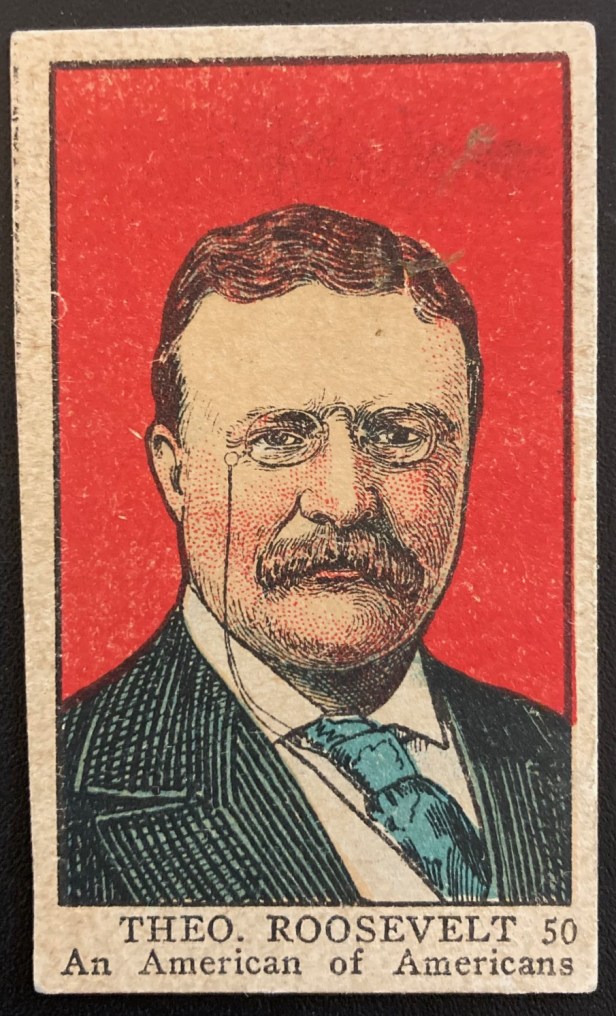
For those not trying to complete this set, these are the cards that are most commonly bought and sold.
Military personnel related to World War I are found in this part of the set. Really, it can probably even be considered as a set on its own to some degree, simply because of the large size of it.
Even though these are important military personnel, the reality is that many of the names are going to be unfamiliar to people with little knowledge of the war. Still, there are plenty of names that are recognizable.
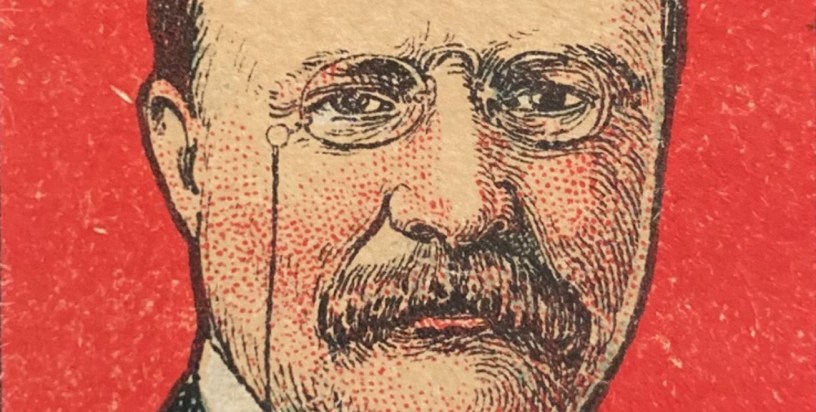
Then U.S. President Woodrow Wilson is, fittingly No. 1 in the set since this is an American release. He’s followed in the set by all sorts of other U.S. officials. In fact, the first 15 cards are all U.S. personnel. Representatives from England, France, Italy, and other nations follow. England’s Prime Minister Winston Churchill is another sought-after card. World War flying aces are another subset of this group. But the most valuable card in the set actually belongs to former President Teddy Roosevelt.
Roosevelt’s ‘involvement’ in the war is an interesting one. He had been out of office for several years prior but actually tried to assemble a group of volunteer fighters. He and current President Wilson also did not see eye to eye on many things surrounding the war. And the fact that Roosevelt’s own son, an aviator, was shot down during the war did not help matters. While Congress did allow Roosevelt to assemble groups of volunteer fighters, Wilson essentially rebuffed their efforts.
While most commons in the set sell for only a few dollars typically, Roosevelt’s card in good condition can sell for $50-$100.
Part 2: War Scenes (Cards 81-120)
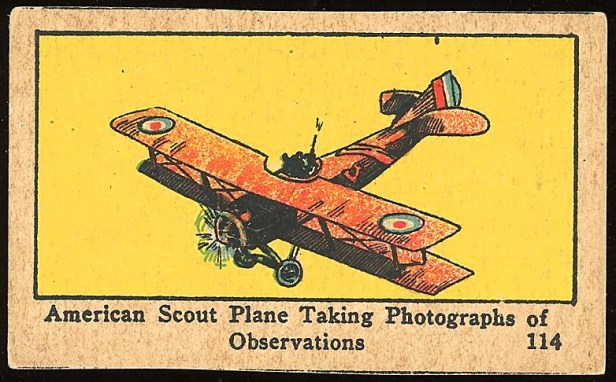 The second primary subset pictures a variety of war-time scenes.
These cards do depict some actual machinery and equipment used in the war. They are also often separated out by country. While some American collectors may particularly seek the cards related to the USA, there isn’t too much notable in this series.
The most intriguing cards in the subset are likely those from No. 110-120, which picture planes and other flying machinery. Aviation cards have gotten more popular and, even though there are no actual subjects named, the names of the actual planes are actually included on several.
This subset, too, can be broken down a bit more specifically. Cards 81-100 feature equipment/weapons. Cards No. 101-109 feature tanks. And cards No. 110-120 feature the aforementioned aviation sector.
Commons in this subset generally sell for a few dollars.
Part 3: Military Insignias (Cards 121-200)
 For anyone building this set, it is easy to see that the military insignias are generally the most difficult to find. Of the roughly 20 cards I need to complete this set, most are in this grouping.
It is unclear if these were produced in smaller quantities. However, in my experience in tracking them down, these are the ones I see the least.
That could be mere coincidence. But given that these are the highest numbers of cards in the set (and many high-number cards in other sets are rarer), I do not believe it to be so. It is possible, even, that all 200 cards were not printed at the same time.
These military insignia cards do look pretty nice. A few of them are quite unusual looking. And while I am no real expert on the links between the insignias and the groups they represent themselves, I do think this one with the Statue of Liberty for the 77th Division out of New York is one of the more desirable ones in the subset. That is particularly because early Statue of Liberty cards have really gotten more valuable in the last few years.
I would not be surprised if this one was the most desirable one in the subset. However, I will also concede that long-time collectors of this set may know of a particular one that is harder to obtain.
Despite their rarity, most commons from this subset do not sell for much more than the others.
Valentine Cards?
A final note to the set is that cards numbered 1-40 can be found with a special back.
While all other cards in the set are blank-backed, these first cards can be found as, essentially, poster cuts. The backs assembled together create, a framed Valentine’s Day message, of all things. Those cards have more of a white back as opposed to the brown backs found on others. They are also printed on a thicker card stock.
While interesting, the Valentine-backed cards do not generally so for more or less. And it is not immediately known, which is rarer. Of my own 40 cards, I have 19 with the Valentine’s Day backs.
We also have no real idea why they exist. The combination of a military set with a Valentine’s Day message is intriguing but it isn’t known why they were even created with that back.
Want more talk about pre-war cards? Follow me on Twitter / X here.
 Pre-War Collector