I’ve got a bit of a love/hate relationship with postcards. While I’ve had hundreds of pre-war sports postcards, there are few that really capture my imagination. I do collect some, including those that picture actual baseball players or the Earl Christy football series’. But even those are really just side projects and not significant interests.
If you’re a football fan looking for pre-war issues, the downside is that there is really a lack of traditional cards out there. However, that is more than made up for by a large amount of postcards. While there are many postcards that depict generic subjects or fans of college teams, the real prizes are the ones that depict actual players. A great many postcards exist of irrelevant high school teams or players. But there are some that picture college players — some of which went on to play professionally or were All-Americans, making them desirable. One such series was the 1905 Dominoe Team Postcards, but there are many other team issues out there, such as the popular 1907 Michigan Dietsche Postcards.
While I’m familiar with those sets, they are all quite rare. I do not know of any college football postcard picturing real players from the pre-war era that would not be considered rare. They all had seemingly low print runs, which makes sense because their appeal would have been quite limited with more of a regional focus.
But I stumbled upon a great card recently that went a bit under the radar. And that is probably because most of the collegiate football stars in the pre-war era are simply not well-known. With professional football in its infancy, most players, even the good ones, were destined for other things. Some were even good enough athletes to turn pro in baseball.
Arthur Dearborn Postcard
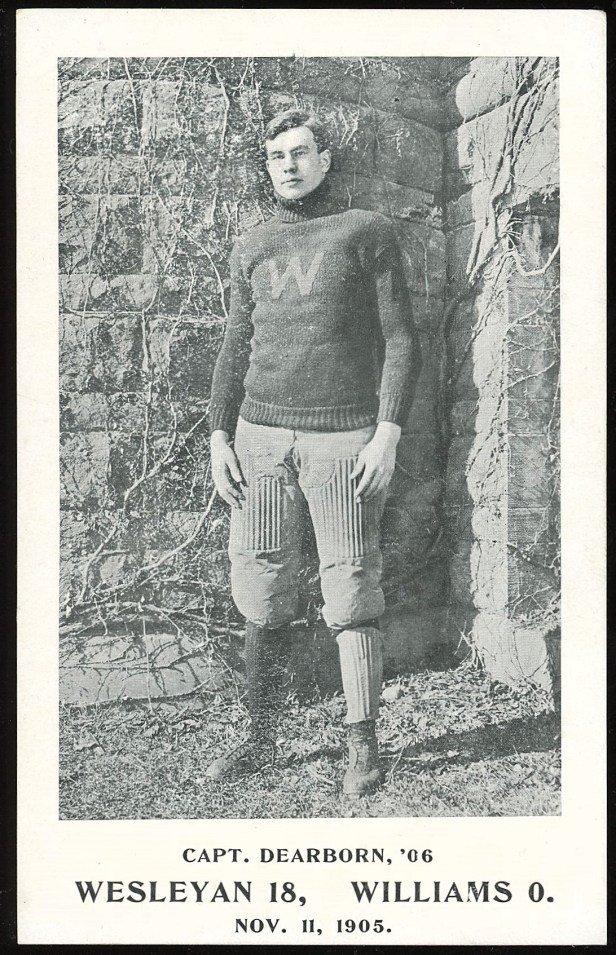
This postcard I picked up recently was a type of card that was somewhat common for the era. It was printed in the aftermath of a game. Many postcards included a blank box score/scoreboard for fans to fill in the score by quarter of a particular game.
In the case of this one, this was a post-game card for a football contest between Wesleyan and Williams in 1905. Wesleyan, for the record, was a strong team that year, going 7-2-1. Prior to the last game of the season (a loss against Swarthmore), Wesleyan’s only other defeat was in the second game to eventual national champion Yale. Swarthmore, which defeated Wesleyan in the finale was 8-1 while Yale was a perfect 10-0, so their two defeats were to two of the top teams in the sport. Williams, on the other hand, was only 6-5 on the season that year.
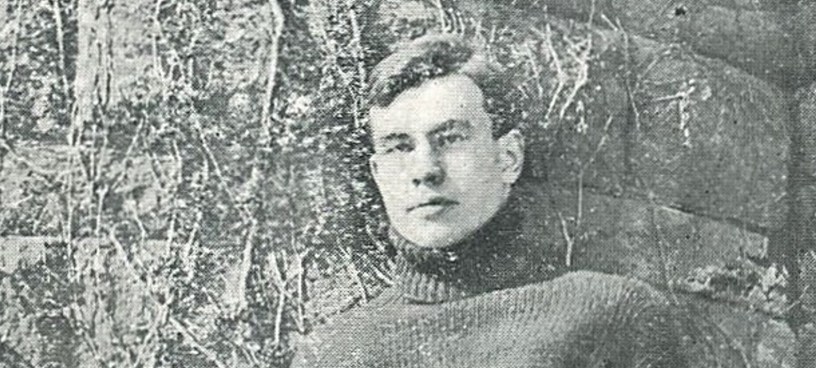
The player pictured is known only as Captain Dearborn. But no other details are provided and, given the fact that he is wearing a W on his sweater, it’s not even clear which team he is playing for — Wesleyan or Williams. But I was able to dig and, without, much trouble learn a lot more.
While Wesleyan was quite good in 1905, the 1906 team took a major step back with a 2-4-1 record. Dearborn, though, was an excellent athlete and a star of the team. He, too, was also a track and field star for the school.
And while Dearborn was a college football player, his real claim to fame would come afterwards, when he participated in the 1908 Summer Olympics for Team USA.
Dearborn was such an athlete that he participated in three events — the Greek discus throw, the conventional discus throw, and on Team USA’s squad for tug of war. He performed extremely well, too. Dearborn had real promise in the discus throwing events, in particular. He finished in second place in both events at the AAU championships in the year prior to the Olympics, in 1907. But unfortunately for him, he finished just outside of a medal in both (4th in the Greek style event and 5th in the conventional style). Both performances were strong as 23 competitors participated in the Greek event with a whopping 42 in the conventional event. The U.S. tug of war team finished only 5th.
Sorting out the Date of Issue
Even though the postcard references a 1905 game, it mentions that Dearborn is seemingly the 1906 team captain. That would make this a 1906 postcard, right?
Not exactly.
The cards were actually first issued in 1905. That is evident because I have seen an example of it with a postmarked 1905 date from November 14, a mere three days after the game was played. These cards were not only issued in the same year, but almost immediately after the game.
This was actually a somewhat common practice. With no television and without even football games on radio, postcards like these were often used to share scores of games across the country.
What’s really interesting here is the apparent proclamation that Dearborn was the 1906 captain. But while researching it, the only references I find to Dearborn serving as the captain were for the 1905 season. It is possible, I suppose, that he was preemptively named the captain for 1906, too, even during the 1905 season But the more likely scenario to me is that the 1906 date actually refers to Dearborn’s year of graduation.
Other Wesleyan Postcards?
My initial thought was that this was likely part of a full set of Wesleyan players. Singling out the Williams game in particular seems odd. The team had many other victories that year and Williams was one of their lesser opponents.
However, Dearborn’s postcard is the only other one featuring a player from the team that I have come across — and all have simply been for the Wesleyan-Williams game.
Interestingly enough, though, the card does appear to be a part of a small set of at least two cards. A second card also references the Wesleyan-Williams score, but is a horizontal card with general game action and no players named.
Want more talk about pre-war cards? Follow me on Twitter / X here.
 Pre-War Collector