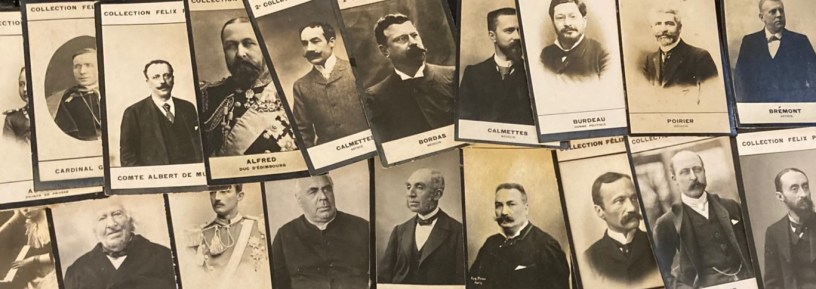
One of my favorite ‘pastimes’ is really diving into fascinating sets that are not often discussed. Many of these sets are notable in their own right but public information that is readily accessible is often lacking. That’s part of what I enjoy writing about.
One such collection of sets are the cards that comprise the Felix Potin series’. I’ll going to do some deep dives into the four different sets issued by Felix Potin in upcoming articles. One of the highlights will be the uploading of all of the albums with pictures of the cards in each set. But this first article is going to start by providing an introduction on the cards since there’s a lot to focus on about the sets in general and I know this isn’t an issue that many are familiar with.
About Felix Potin
Felix Potin was a large company based in France starting in the 1840s. The company was founded by, you guessed it, Felix Potin, and grew into a large retail network offering all sorts of products. One of those products was chocolate, as is evidenced by any number of 19th century trade cards you can find advertising that item. Here’s a written history with more info on Potin the man and his business.
How exactly they were distributed is something I’ve not been able to find out. But it is believed that the company issued four different sets of ‘picture cards’ with a chocolate product.
Potin apparently opened his first store in 1944 when he was only 24 and never looked back. Even after his death more than 100 years later, the company had more than 1,000 shops. Thought bought out at that time, the company effectively lasted until the 1990s before re-emerging with the same name after another sale of the company.
While Potin was the man behind the company, we can say that he was not the man behind the actual production of the cards. Potin died in his early 50s in 1871, well before the cards were ever printed. It is not known who came up with the idea for the cards or even why they did so.
The Cards
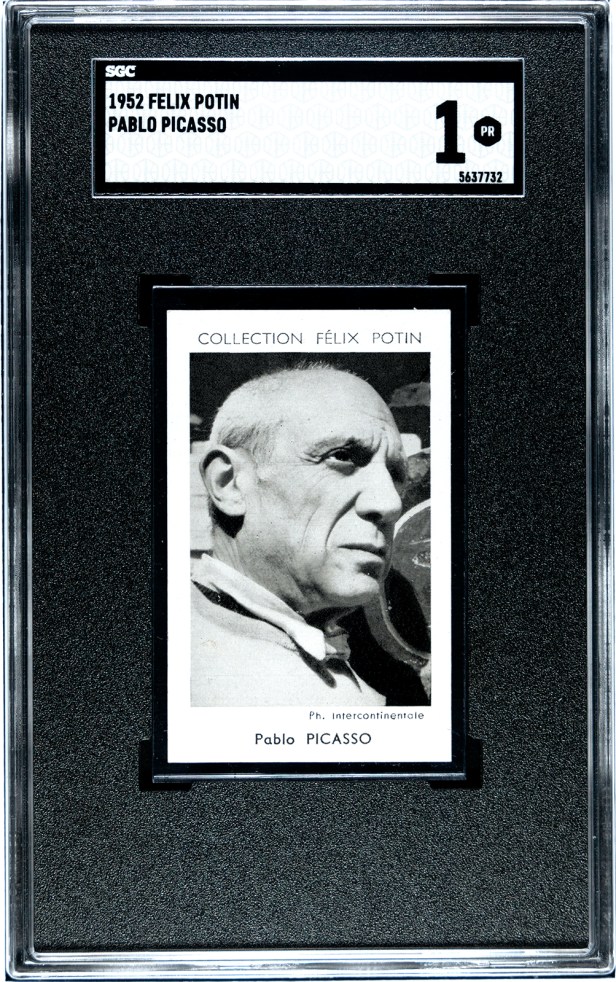
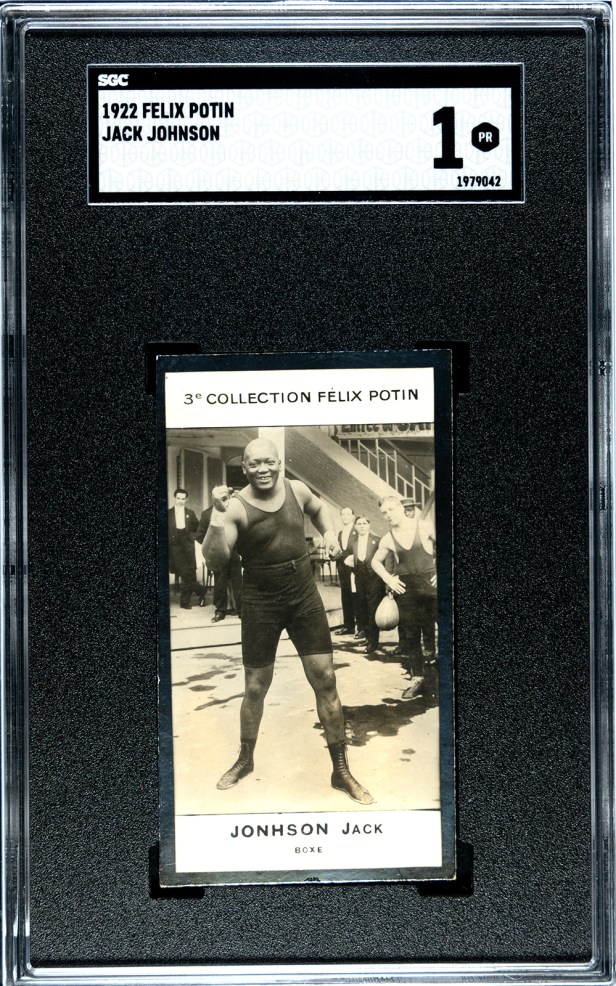
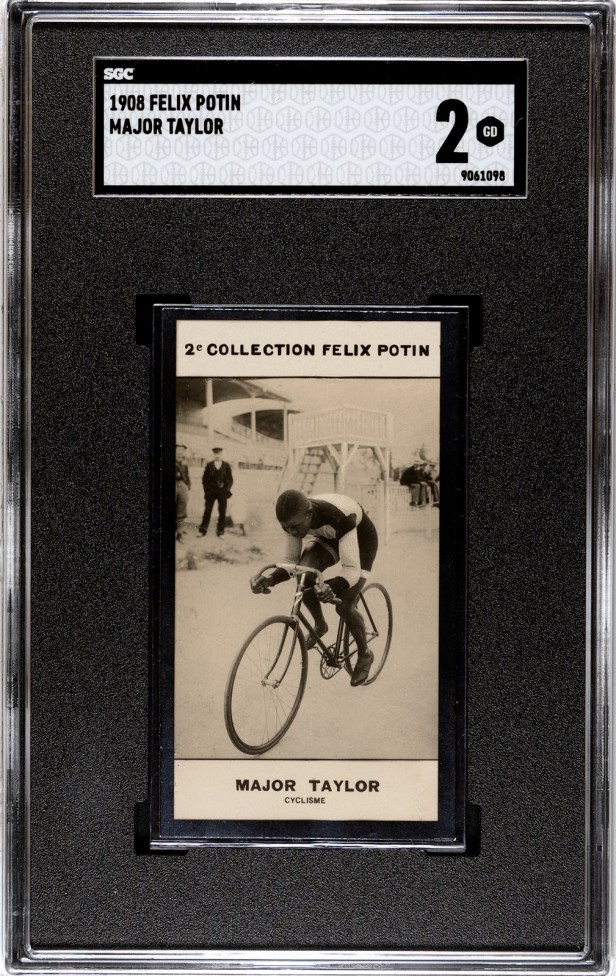 While the dates of the first set are a bit fuzzy, in general, Series 1 appears to have been released sometime between 1898-1908, Series 2 in (and possibly around) 1908, Series 3 in 1922, and Series 4 in 1952. Altogether, there are a little more than 1,800 total cards, not including the numerous variations.
Formally, the name of the sets is: Felix Potin’s “Celebrities Contemporaines” (Contemporary Celebrities). That name is on the cover of all of the albums. While Felix Potin did produce some other trading cards, these four sets are the ones we’re going to focus on.
The cards were slightly bigger than the ones designed for tobacco and candy cards around the same time period. Measuring 1 5/8″ wide by 3″ tall, they are somewhere in between those smaller, narrower cards, and the traditional cards of today.
The first three series’ from the pre-war era all have the same general look with black borders. A good way to describe these is as ‘picture cards.’ While certainly being trading cards, they are also a bit like miniature photographs. Unlike some other album type cards that were printed very thin, these semi-gloss cards are slightly thicker and not paper thin by any means.
The last of the four series’ from 1952 is a different card. Those are a bit thinner, as well as smaller and closer in shape to a square.
Backs of the cards are blank. That was undoubtedly because they were designed to be pasted into collectible albums, so they could not even be viewed afterwards. Some album cards did still print backs with descriptions pertaining to the subject. These cards, however, did not.
Back damage, by the way, is quite common in these sets. Many collectors have removed them from albums and it is frequent to see them with paper loss, added paper (if part of the album page is still stuck on it), or in some cases, with the card still fully glued to the page but cut out completely.
eBay has many of these cards available, though the ones you will most commonly see there are cards from Series 1, 2, and 4. Series 3 cards are much harder to find. If you’re a setbuilder, you will have an extremely difficult time trying to individually piece the sets together. Your best bet would be to buy complete albums with the cards pasted into them. And in those cases, while Series 1 and 2 albums are seen with some regularity, Series 3 and 4 cards are more difficult to find.
So what kind of cards will you find in the sets?
The Subjects
Because the cards are from France, there is certainly a real highlight on subjects from that country. However, it truly is a worldwide set with many countries represented, including the U.S.
The majority of the subjects are non-sports figures. A great many, particularly in the first series, are world leaders, political figures, and military subjects. That sort of waned a little as the other series’ came out, but those types of subjects are seen quite a bit early on. The sets also included doctors/medical subjects, scientists, authors, and others types of working professionals. Quite popular are the subjects focused around arts and theater, including artists, composers, musicians, actors/actresses, and of course, the athletes.
Much like the sets issued out of the UK for Ogden’s Cigarettes products, these cards included a real hodgepodge of subjects. The two types of cards do certainly vary. Ogden’s included almost everything under the sun, including buildings, animals, and all kinds of unnamed subjects. But in terms of the variety of famous people included, the Felix Potin cards do have quite a bit in common with the Ogden’s sets.
If you’re into sports, though, you’ll be pleased to know that there are a decent number of athletes here, even if they aren’t necessarily the highlight.
Okay, Sports
Sports fans are going to be a little less enthusiastic about the earlier sets of these cards. While sports was highlighted quite a bit in Series 3 and 4, it was not seen too often in Series 1 and 2. All of that said, there are plenty of notable sports cards found in the sets. In all, you’ll find more than 200 athletes in these sets.
One of the popular athletes in the set is world champion cyclist, Major Taylor. Taylor has two different variations and his cards typically start in the $100-$200 range.
Other keys to the sports issues are boxing cards of both Jack Johnson and Jack Dempsey. While the card for Johnson comes later in his career, the one of Dempsey is legitimately one of his earliest cards. Both of these are rare.
Other sports covered in the set including wrestling, auto racing, tennis, soccer, rugby and more. While none of the four major American sports are included in it, there’s plenty else here. We’ll dive into which sets contain which cards as we go through this series.
Variations
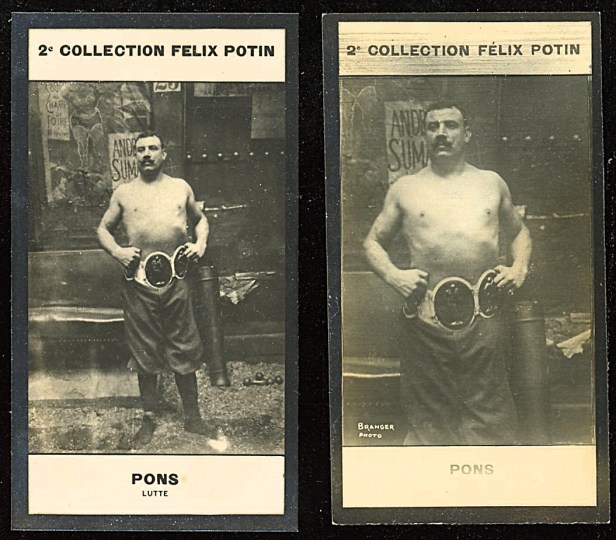 Lost to many is that there are loads of variations in the sets.
One type of variation are pose variations. While those are somewhat few, they do exist. Thomas Edison, for example, has three different pictures in the first album.
Others were related to title changes. US President William McKinley is in the set as a world leader. However, he has a second card that removes his title as President, because it was likely printed following his 1901 assassination.
On top of those, however, are a slew of minor variations with slight photo cropping differences or credits to the images. Shown here are two cards of wrestling champion Paul Pons. One pictures a cropped photo of Pons, making him appear closer. Also, a photo credit name is printed in small font in the lower left corner.
Additionally, it is notable that many of the images appear to be prints of actual cards, with the Felix Potin banner at the top and the lower banner at the bottom having a ‘blurry’ look, as if it was a photocopy. While that generally means a card is a fake, that is not usually the case here. Many of these cards exist and they all appear to be just as legitimately produced by the company.
That’s an introduction to the cards in general. Next time, we’ll be taking a close look at the first series.
Want more talk about pre-war cards? Follow me on Twitter / X here.
 Pre-War Collector
Comments are closed.