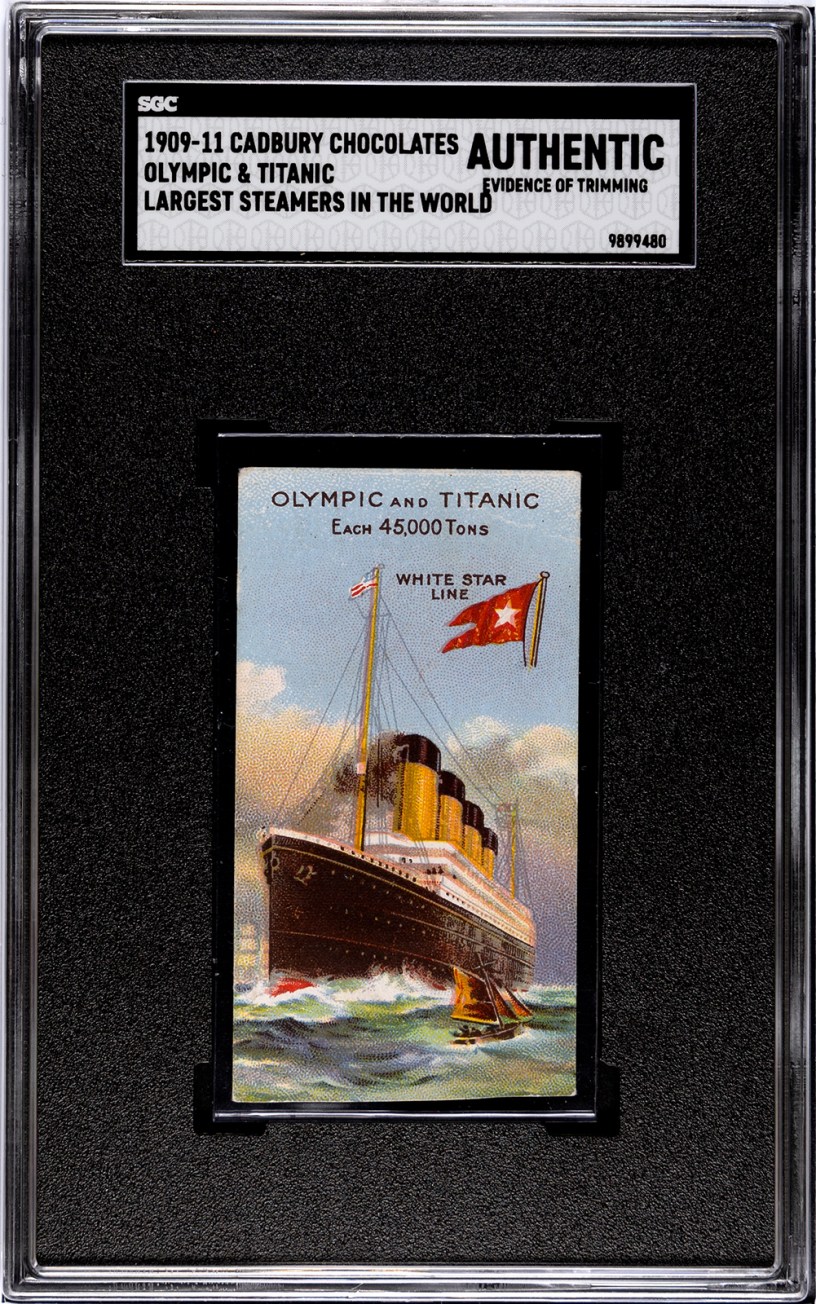
More than 100 years after its demise, the Titanic remains the most popular ship in history. Infamously sinking when it struck an iceberg in April 1912 on its maiden voyage, items surrounding the Titanic have always been heavily collected.
However, with non-sports cards on the move, a particular card of the Titanic has become a hot item among collectors: The Cadbury Chocolates / Bournville Cocoa card.
Issued by Cadbury for its Bournville Cocoa product, the card has been a popular one in the last few years. It has gone from being a relatively obscure card (at least to most American collectors) to being incredibly well-known in non-sports circles.
Why So Few Early Titanic Cards?
The majority of Titanic cards were not released until after the ship’s sinking and this is one of the few known ones to be issued before it set sail. The lone exception to that is postcards, which do exist in greater numbers for the ship.
That has always been somewhat of a fascination to me until I gave it a bit more thought. In hindsight, it is relatively easy to see why the ship was not featured on more early cards.
It was long-hailed as the greatest ship in the world as it was being constructed. And, as a point of comparison, the Statue of Liberty, which was heavily advertised before its construction, is featured on numerous Victorian trade cards before it was even built. It might seem odd that more trading cards of the Titanic were not created given that knowledge.
But perhaps the answer lies in the fact that trading cards out of the UK were still somewhat in their infancy at the time and the ship was, of course, a British liner traveling to the United States. While cigarette cards were mostly phased out in the U.S. by 1920, at that time, they were really just beginning to take off in the UK. If the Titanic were an American ship or if it was constructed later, there would undoubtedly be more cards featuring it prior to its maiden trip.
Let’s take a closer look at the actual card.
The Cadbury / Bournville Cocoa Olympic and Titanic Card
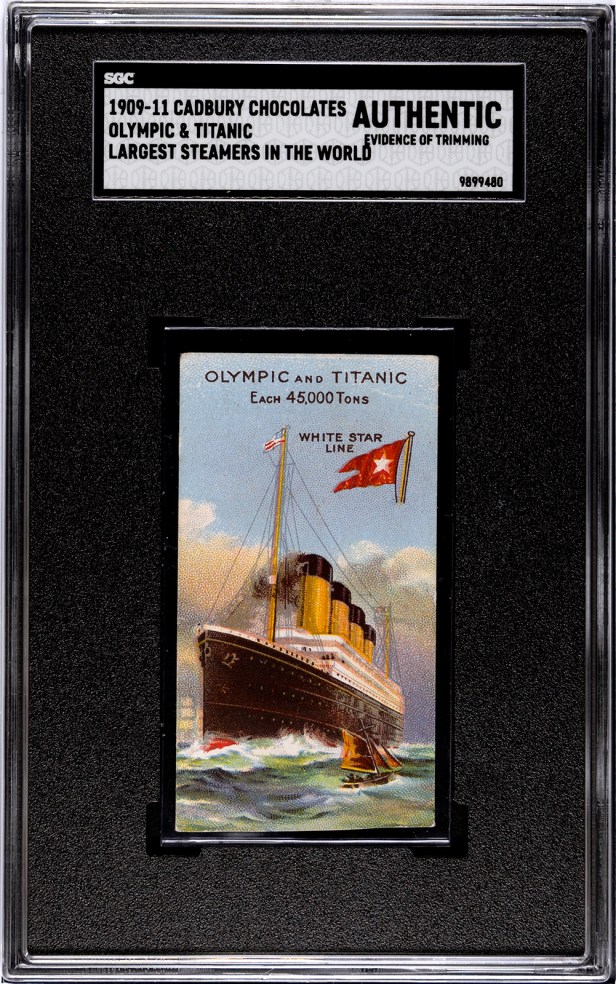 The date of issue of the Cadbury Olympic and Titanic card is relatively fuzzy. PSA declares it to be a 1911 issue while SGC grades these cards as a 1909-11 issue. Beckett, too, has graded these as 1909-11 cards. And while its value is not too high by comparison, it often is given the holy grail moniker among Titanic cards.
The card is an art depiction of the ship, picturing it sailing even while the cards were issued before its first trip. The ship was part of the White Star Line as noted on the card with a mention of the Olympic, another vessel in the line. More on the particular image in a bit since, really, it is meant ton represent both ships.
Backs of the card include an advertisement for Cadbury Chocolates and Bournville Cocoa. It is interesting that, despite being a card for Cadbury’s Bournville Cocoa product, it is generally referred to as a Cadbury card instead of a Bournville one.
Shown here is my own example. Mine, like some others, has the bottom trimmed. I am not sure why the “Largest Steamers in the World” text at the bottom was so offensive to collectors. But that part is sometimes cut off as if it was a tobacco advertisement on a 19th century card.
Finally, while there could be earlier postcards of the famous ship, this is considered to be the Titanic’s first card. That is seemingly difficult to refute 100%, even if it is untrue, given the estimated 1909-11 timeframe. Most collectors consider this to be the Titanic’s first true trading card.
The Titanic … or the Olympic?
 One of the more intriguing thoughts that rarely comes up for discussion is which ship is depicted on the card. While both the Olympic and the Titanic are named, it isn’t immediately clear which ship is actually shown. And that is because, while there were differences in the two ships, they are practically identical from the outside. The Olympic was another ship in the White Star Line and the pair are often referred to as sister ships since they look so similar.
Unfortunately, some of the key differences in the ships are the windows, which are on the side and not shown well in the pictures. Differences also exist in the interior of the ship, which are not shown, either.
Despite that, however, this is almost always sold as a Titanic card. And given the close nature of the design of the ships’ exterior, it can almost be assumed that a picture was used that could represent either ship. Calling it a legitimate Titanic card is not a stretch.
It should be noted that both PSA and SGC correctly note the cards as representing both the Titanic and the Olympic.
Price and Rarity
The cards are quite rare, though you can usually find some on eBay. To date, PSA has graded 46 of them while SGC has graded 38. Those numbers are a bit deceiving. While more and more are finding their way into slabs since the cards have gotten more valuable, it is still pretty common to see raw examples, too. Part of that is because a good many of these cards are still located in the UK as evidenced by recent sellers on eBay.
Prices can be all over the map a bit but low-grade cards typically start in the $250-$500 range with nicer ones commanding more. An SGC in a straight auction recently sold for nearly $1,000. Buy it Now prices on eBay auction listings are often priced exorbitantly. Your best bet in trying to determine a true value is almost always going to be in reviewing the sold listings to see what cards have actually sold for instead of asking prices.
While I consider trying to gauge future values of cards a difficult task, I do think this particular card has excellent room to grow for three reasons. First, large quantities of it do not exist. Second, non-sports cards are growing significantly and the Titanic will always be a popular subject. Finally, the card is somewhat inexpensive compared to other Titanic collectibles. Newspapers, for example, touting the Titanic’s demise often sell for $300-$500. And often in sports cards, newspapers do not fetch as much compared to contemporary cards.
There is no definitive way to predict what will increase or decrease in value. But given the rise of non-sports cards in particular, I do think the Titanic card has good room for growth.
 Pre-War Collector