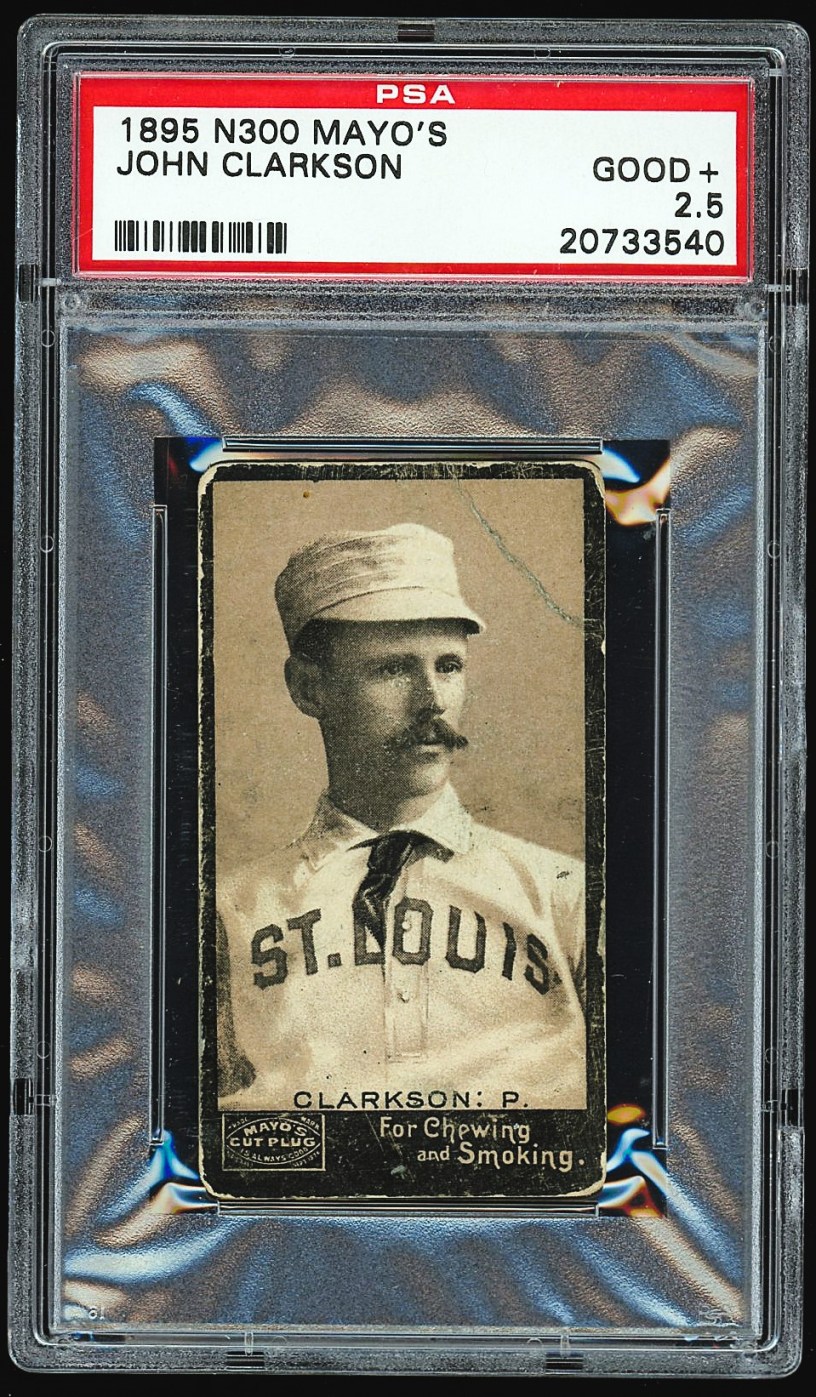
The thing I’ve always liked the most about the N300 Mayo Baseball cards was that, aside from the similar 1894 Mayo Football cards, there simply are not other cards that look like them.
The cards are black and white (or sepia, in some cases) and have only black borders. One of my favorite features of the cards are the plain, but all-black backs. They look completely different from the other 19th century cards as well as the later tobacco cards, like T206. Simply put, there is nothing like them.
The cards were issued with Mayo’s Cut Plug tobacco, as indicated in a small advertisement at the bottom of each one. And like other tobacco issues that had similar ad placement, it is quite common to find these with that bottom part trimmed off — which, sadly, greatly decreases the value.
The cards’ makeup is also different from other sets. Measuring about 1 5/8″ by 2 7/8″, they are slightly bigger than your typical tobacco cards. Sadly, their size does not make them candidates for the 20-pocket or the 15-pocket tobacco card pages. The best way to store these in a binder is likely in a 9-pocket page or in a protective holder inside of 4-pocket postcard-sized pages (which will also accommodate graded cards). The thickness is also somewhere in between an Old Judge card and the much thinner early tobacco cards from the 20th century.
Mayo issued a few other sets advertising their products, including a set of die-cut baseball players, catalogued as N301. Another one is the N310 series of prizefighters. However, the other set that is most widely regarded is the aforementioned 1894 Mayo Football cards, which basically has the same look as these but featured college football players. That set, by the way, is actually recognized as the first true set of football cards featuring real players.
The N300 Mayo Baseball set checks a lot of boxes — great checklist, fantastic design, and in the heavily-desired tobacco card market. So why aren’t these more collected? After all, many collectors have never even seen one in person.
Mostly because of the rarity, I’m convinced. There are plenty of Hall of Famers in the set, many of which can be found in the highly-collectible Old Judge set issued a few years before this one. No, they aren’t impossible to find. But given that you can usually only find a few dozen on eBay at any given time, they are much rarer than even known difficult series’, such as T207.
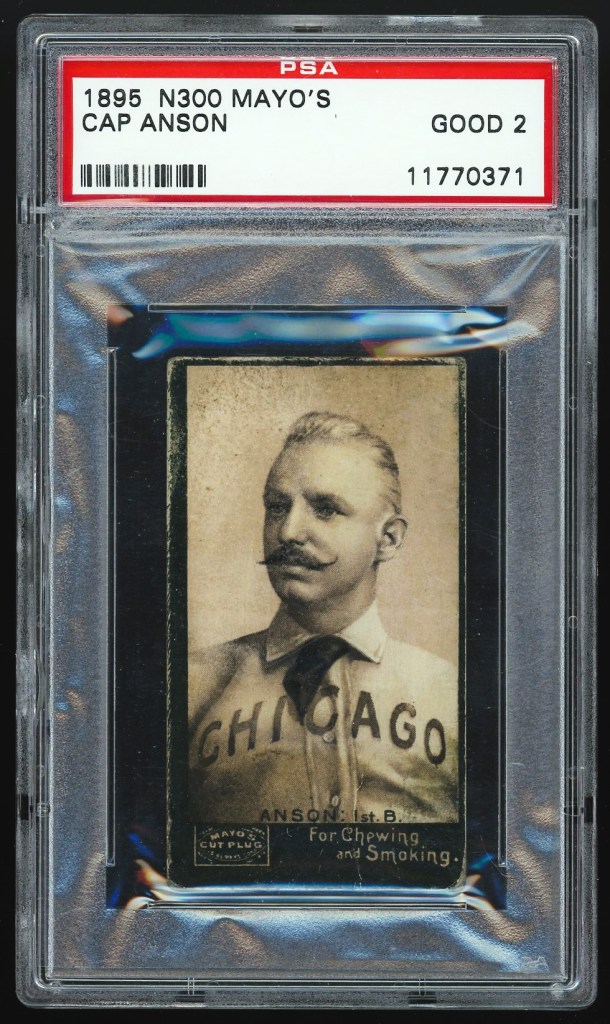
I’ve always liked the N300 Mayo baseball cards but I didn’t buy one until this year. I’d also been craving a Cap Anson, so this PSA 2 shown here scratched both of those itches. Anson is the most famous player in the set, and one of many Hall of Famers, including the likes of John Clarkson, Dan Brouthers, Hugh Duffy, Buck Ewing, Kid Nichols, John Ward, Amos Rusie, and more. As if the set was not difficult enough to build, some of those players have more than one card to reflect trades, correct misspellings (Rusie), or, in the case of Ward, denote that he went from being an active player to a retired one. The set also has a number of established stars, including Jack Glasscock, Bill Dahlen, and others that aren’t quite Hall of Famers but usually sell for more than common players do.
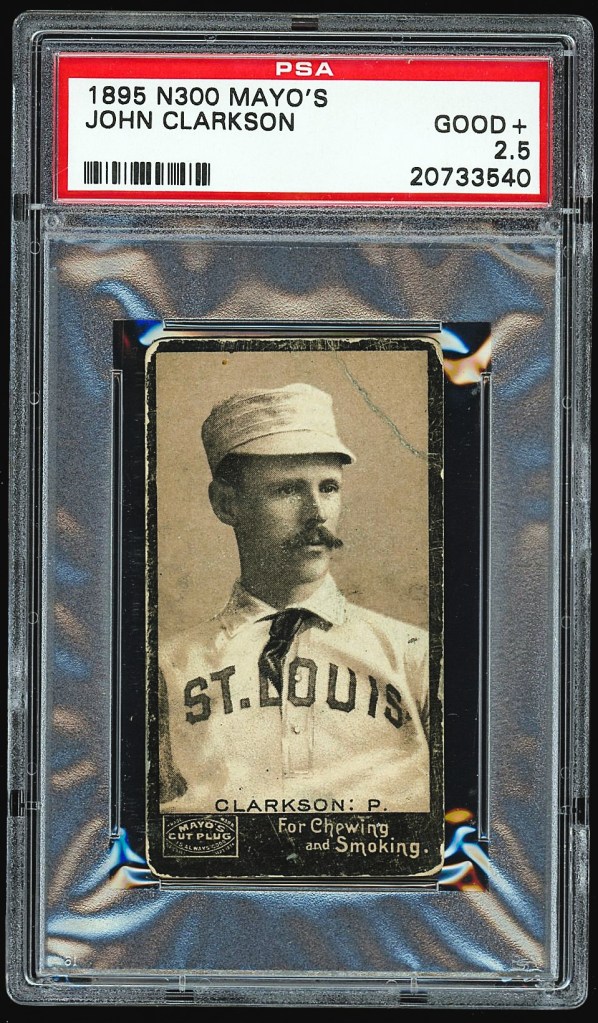
With only a single card and no plans to buy another, building a complete set was the farthest thing from my mind. But that changed this week, when I landed this PSA 2.5 of another Hall of Famer in the set, John Clarkson.
Now, the set includes a total of 48 cards (40 without variations, most of which are team changes). And the team changes, in fact, seem to point to a set that was issued in 1894 and 1895, instead of the sole-1895 distribution that is often claimed. So while that is not technically a lot of cards, it is an extremely difficult set to build because of the rarity. But as my Allen & Ginter N28/N29 set builds come to a close, I also find myself in need of a new project. And, difficult as it may be, I’m going to start working on the Mayo set.
Another reason this set is not collected all that much? It’s not an affordable one by any means. Even respectable lower-graded common cards typically start around $200-$300.
I previously avoided this set for years, thinking it was a virtual impossibility. And given the few amount of complete sets that likely exists, I’m not sure that line of thinking is incorrect. Still, I’m enamored with these fascinating cards and, if completing a set doesn’t happen, I’ll at least have more of them in my collection. And that’s a positive.
Thus far, I’ve only got two of these to my name. But given that I want to focus on this set, I’m sure I’ll have a few more before I know it.
Want more talk about pre-war cards? Follow me on Twitter / X here.
 Pre-War Collector
Comments are closed.