
A total of 248 cards make up the three 1910-12 Imperial Lacrosse sets, C59, C60, and C61. Most collectors are not familiar with these issues, but their importance cannot be understated as they are generally recognized as the first trading card sets of the sport of lacrosse. And while lacrosse card collecting is a relatively small subset of the hobby, the first of anything is notable.
What you might already know is that lacrosse and ice hockey are virtually joined at the hip in Canada as both are considered national sports in that country. But more important to this discussion is that many professional athletes in the country played both in their early days. Several players in the Imperial Lacrosse sets were also hockey players, and some even also appeared in the Imperial hockey sets produced around the same time.
And the biggest name in the lacrosse sets is that of Edouard Lalonde, otherwise known as Newsy.
Newsy Lalonde dominated in both sports — so much so that he ultimately became a member of the Hall of Fame for each. He was also one of the top scorers in both sports and has ranked as the top player from his generation in both sports by several sources. Even more than a century later, Lalonde is still a legend in Canada.
Lalonde has four cards in the three Imperial Lacrosse sets (he also appears in each of the three Imperial hockey sets, too). I’ve been working on the lacrosse sets and have about 160 of the 248 total cards. Recently, I was glad to pick up the fourth of the Lalondes. I thought a post on these would help as there’s some confusion (perhaps even with grading companies) regarding them.
1910 C60 Imperial Lacrosse (No. 97) — Rookie Card
 Similar to the T205, T206, and T207 baseball card sets, the C59, C60, and C61 Imperial Lacrosse sets are chronologically catalogued in a different order. C60 is considered to be a 1910 issue, C59 a 1911 set, and C61 a 1912 set.
It is important to note that, while both the C59 and C60 sets reference players’ 1910 teams, seemingly making them from the same year of release, they are widely considered to be from two separate years. If that is entirely accurate is a question I’ve had since learning about these cards. On the surface, it seems odd that both reference teams from the same year on the back, but they were issued in different years. And for the record, the C61 Imperial Lacrosse cards that reference the 1911 teams are considered to be 1912 cards. However, one thing to note is that the two checklists are virtually the same with only a few differences. It is quite possible that one was printed in 1910 and a second, basically reprinted in 1911. So we’re going to assume the hobby’s got this right and use the dates that have been generally accepted as correct.
Thus, the first of Lalonde’s four cards is recognized as the 1910 C60 Imperial Lacrosse card. If you’re looking for a lacrosse rookie card of the Hall of Famer, this is the one that is most often touted as it.
The card pictures Lalonde as a member of the Canadian National Team and, critically, is identified as (usually) having an orange background. That’s important because the card looks basically the same as one of his C59 cards. Another way to identify this card in particular is the back, which has pair of crossed sticks at the top.
1911 C59 Imperial Lacrosse (No. 97 and No. 100)

As I mentioned, Lalonde has four cards produced in three sets. One of those sets has to have two of his cards, and it’s this one — the 1911 C59 Lacrosse set.
One card has the same pose as Lalonde’s C60 card. He’s wearing the same National Team sweatshirt, the bottom with his name and team is the same, and the card even has the same No. 97 card number. The primary difference on the front is that this one is known to have a redder background.
If you’re looking for the rarest of the four Lalonde’s, this one could possibly be it, according to the population reports. But you should note an important point at the end of this article.
Lalonde’s other card in the set finally gives us a different pose — a portrait.

This one’s also different as it pictures him as a member of his Vancouver team instead of the National Team. And with just a portrait, he’s also missing the stick that he’s seen with in the other two cards.
This card is No. 100 and the final card of that set, which added on No. 99 and No. 100 from the C60 series.
Of the four Lalonde cards I’ve got, this is really the only I’d like to replace someday. While the other two color cards are lower-grade, this one has some paper loss on the front that is a bit distracting. But in terms of just collecting all four, I snatched it up quickly as I’d not seen very many of them available.
1912 C61 Imperial Lacrosse (No. 21)
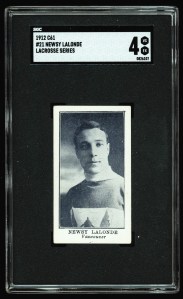 The last of the Lalonde cards is also the one that is the most different from the others.
In 1912, Imperial Lacrosse changed things up, switching from color art cards of players to using real black and white images.
The image used for Lalonde is actually pretty similar to his portrait card in C60. The two are close enough that some might even think that, aside from the sweater differences, the art card was even possibly created from this portrait. That probably isn’t likely, but as you can see, the two images are similar.
This card is certainly tough to come by. I picked up this SGC 4 in part because finding a lower-grade one at a cheaper price was just very difficult. I spent a little bit more on this one as it was the last one I needed and because I was simply tired of waiting for the perfect one to come along. That said, it’s a beautiful card and was a fitting way for me to end my pursuit of this quartet of lacrosse cards of the game’s earliest star.
Pricing and Rarity
The only thing I can say about the Lalonde cards is that they drastically fluctuate in price. I’ve seen some sell for as little as $100 in very low-grade raw condition and others in the same condition sell for double that amount. There doesn’t seem to be any rhyme or reason, or any correlation to the supposed rarity. And of course, pricing goes up for the nicer cards. In general, though, you are more likely to find a low-grade Lalonde starting closer to $200 than you are at $100. The last few raw examples sold on eBay, admittedly a little nicer, sold for about $300.
A note, too, about rarity. The No. 97 card from the C59 set appears to be the rarest, based on PSA’s population reports. Only 16 of those cards have been graded to date while the others all have at least 30. The second rarest one seems to be the black and white C61 card, which was graded next fewest with 30 examples.
My own personal experience in collecting these four cards makes it difficult to determine which is really the rarest. About the only thing I can say with any certainty is that the rookie card with the orange background is easily the one I’ve seen the most.
But regarding the PSA population report in particular, collectors should note that there is some confusion there. PSA has graded Card No. 100 in both C59 and C60 sets, and that card is only known to be in C59. I have never seen a No. 100 example in C60 and Todd Tobias’ excellent lacrosse card website only checklists 98 cards in C60 as well. PSA’s grading of a No. 100 card in C60 appears to be in error, unless legitimate error cards with the wrong back exist.
Thus, while the population reports are helpful, there may be some confusion by graders in determining to which set specific cards belong.
Color and Back Notes
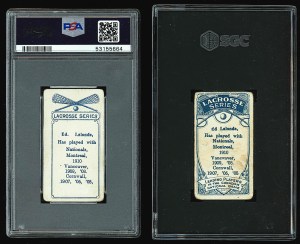 One thing that collectors should note is the color of the backgrounds varies — in some cases, quite a bit.
While most of the C60 Imperial Lacrosse cards of Lalonde have an orange background, print levels of certain inks do not always ensure that was the case. I have seen several C60 cards with a deeper orange background that more closely resembles the C59 cards.
Similarly, while the background for most C59 cards is usually closer to red, I have seen some examples that are closer to the C60 orange color, too.
Since the poses are exactly the same, the best way to distinguish between those two National Team cards of Lalonde is always going to be in viewing the backs. Backs of C60 cards have the crossed lacrosse sticks at the top while backs of the C59 cards have a large shield design. Here are images of both.
Want more talk about pre-war cards? Follow me on Twitter / X here.
 Pre-War Collector