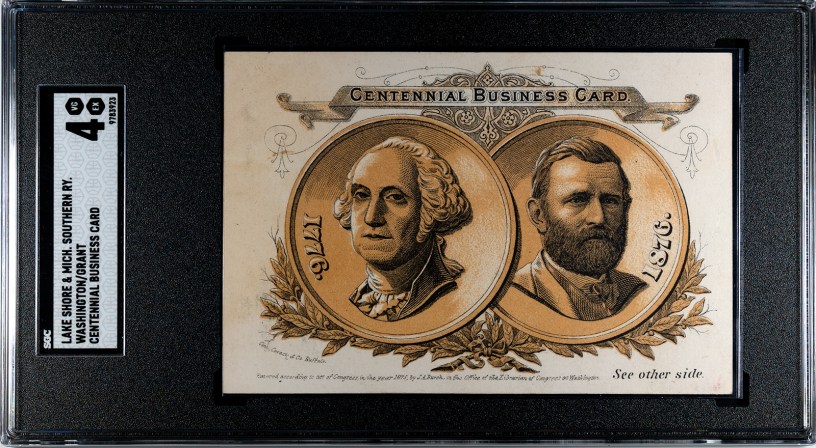
While I collect all kinds of non-sports stuff, a few years ago, I really started getting more into historical cards related to important figures, events, and the U.S. in general. I wouldn’t call it a focal point by any means, but a while back, I began accumulating so much of it that I had to create separate binders for all of my presidential related cards and all of my cards related only to the U.S. So I’m certainly collecting more of it these days than I probably expected to a few years ago.
Many of the cards of those subjects I have are trade card issues. That’s not really by design. But while I do have a great many tobacco and other cards related to former presidents and the U.S., I just stumble upon so many great cards that happen to be advertising trade issues.
 Most people reading this blog are probably familiar with those, but essentially, these were usually cards printed in the 1880s or 1890s with stock imagery and were used to advertise a variety of businesses. While some of the images/cards were issued only for a particular brand, the majority of these cards were used by many businesses. It is not uncommon, for example, to find a card with a particular on it advertising soap and then to find that same card/picture with an advertisement for a kitchen stove. These cards were mostly printed in large batches and then used for whatever businesses wanted to slap their name and information on them.
I came across a trade card that I was fascinated by recently and picked it up. I then shipped it off to SGC, which graded it.
The card in question is called the ‘Centennial Business Card.’ That title runs across the top of the front, which also includes medallions with the first President, George Washington, and then President Ulysses Grant. The card is a celebration of the first 100 years of America, spanning from 1776 to 1876.
History buffs will notice one thing. While Washington’s picture is used on the 1776 medallion, he was not President then. Washington did not become the country’s president until more than a decade later in 1789. But hey, if you’ve got to put someone’s picture there, it might as well be him.
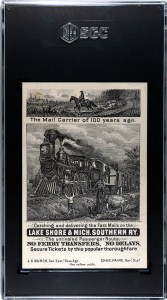
Measuring about 3″ x 4 1/2″, it’s about the size of your typical trade card, even though those vary slightly in size. And while trade cards can have different backs, the few of these I’ve seen have all had the same one — an advertisement for the Lake Shore & Michigan Southern Railway.
The advertisement mentioned that business operating to move passengers from one place to the next, sure. But the focal point actually seemed to be on mail delivery. At the top is a picture of a horseback rider and indicating that was a mail carrier at the time of the country’s formation. The majority of the back is dedicated to the Lake Shore & Michigan Southern Railway’s train and identifying themselves as a mail delivery service.
Date
The exact year of the trade card would seem to be in 1876, of course, since it was a celebration of the centennial. But the card, in small print, also indicates that its origins might date to 1875.
The front of the card indicates that the card states:
Entered according to act of Congress, in the year 1875, by J.A. Burch, in the Office of the Librarian of Congress at Washington.
That doesn’t guarantee it was printed then, of course. That only indicates when the card/design was registered and being claimed as a copyright. I suppose it is possible that the first examples were printed later that year leading into 1876 but this is generally referred to as an 1876 card.
Reprinted Postcards
Collectors wanting to buy one of these should know that the majority seen out there are actually reprinted postcards from much later.
The postcards are commonly dated to c1970, and chances are that they were probably created around the bicentennial of 1976. The backs of the postcards reference that they are an exact reproduction of the original business card from 1876 and that a new 200 years of freedom logo was added to some of them. The postcard back generally makes those easy to distinguish from the original 19th century trade cards.
It is difficult to imagine a card being printed to celebrate 200 years would be printed several years early. So my best guess is that they were issued in or very closely to 1976.
Another interesting note with these is that the original trade card used to produce them was offered by noted postcard collector Ben Shiffrin of New York. He was known as one of the largest postcard collectors and the back of the postcards mention that the picture for the postcard came from the card in his personal collection.
Baseball Tie
 After I got the card, I took a closer look at it and recognized a familiar name.
While not always the case, many Victorian era trade cards will indicate the creator and/or printer. And tucked away on this one, sure enough, was the name of Cosack & Company based out of Buffalo.
Cosack and Company was a lithography and publishing company. You’ll find their name on many old trade cards and, while some collectors might recognize the blue-bordered cards here, fewer will know the name that produced them was in fact Cosack and Company.
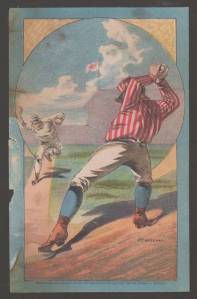
These baseball cards are dated to 1882 and were produced in a small set. They are usually referred to as the Circled Positions cards, since they picture baseball players all over the diamond and were printed without captions or any better way to identify them. They are also catalogued as H804-11. Here’s a picture of one I used to own.
Kind of a cool sports tie to a series of cards that were focused on America’s pastime — baseball.
Rarity and Value
While you will find the reprinted postcards much more frequently, these trade cards are tougher to find. They aren’t scarce, though, and in raw condition, they usually start around $40-$50 or so, depending on condition. The reprinted postcards, of course, are worth much less. You can usually find those for $3-$5.
Want more talk about pre-war cards? Follow me on Twitter / X here.
 Pre-War Collector