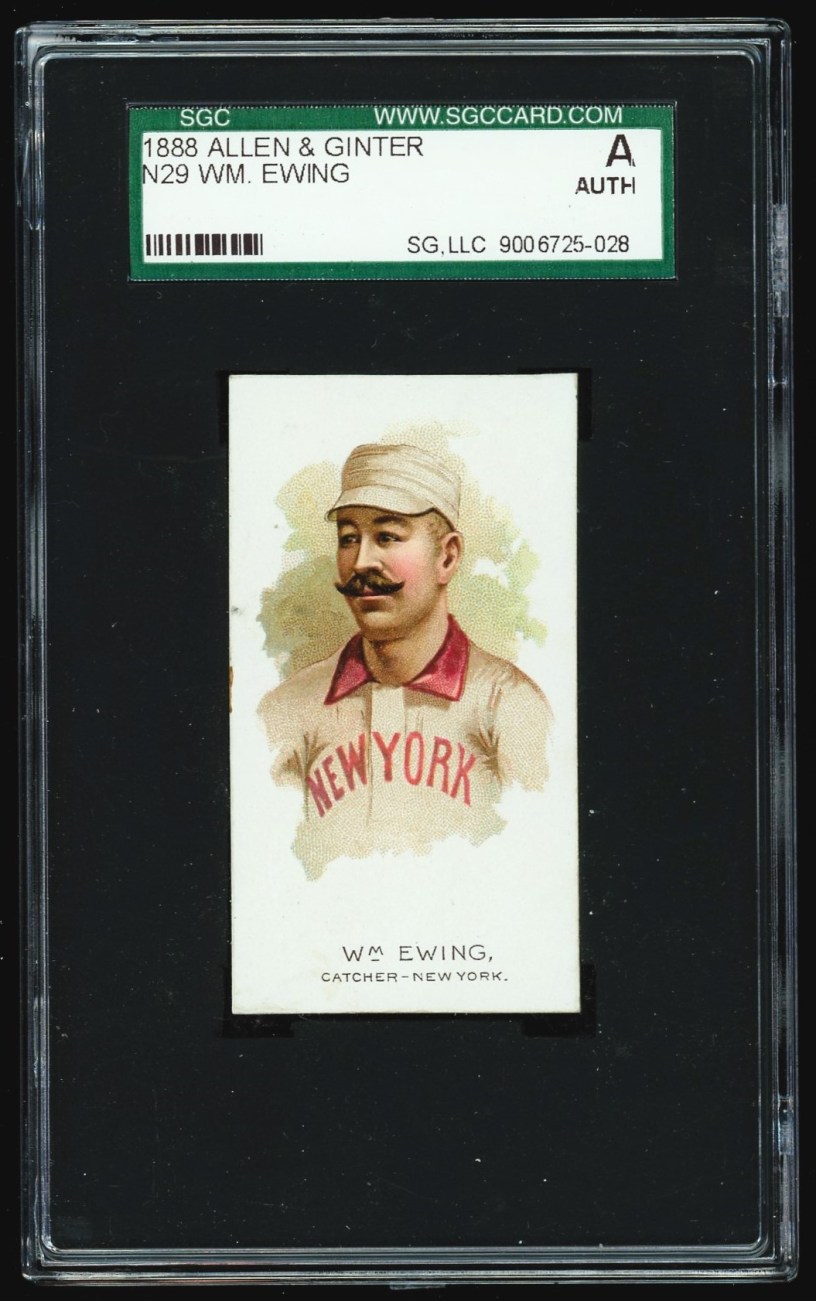
I’ve always been fascinated with the Allen & Ginter Champions cards. Early on when I got into pre-war, I was pretty determined to work on those two sets, N28 and N29.
I was slightly less motivated at the time, because I wasn’t into much other stuff besides baseball — and those multi-sport series’ contain a lot more than that. But still, I couldn’t get over the crisp artwork coupled with the fairly distinctive all white backgrounds.
 One thing I’ve always gotten a kick out of are the modern discussions surrounding the new Allen & Ginter cards being distributed today. Widespread complaints are commonly that the sets include too much random stuff or that there’s not enough focus on baseball. Now, while I will fully agree that some of the cards seem a bit far-fetched, that was always the point of their stuff. Even beyond the sports-themed Champions sets, Allen & Ginter made cards of all kinds of things. Baseball is represented in those sets to a small degree, because the sport was a very small part of their original cards in the 19th century.
And as my collecting tastes branched out a bit, frankly, that is what made the Allen & Ginter cards so desirable. I’ve got all kinds of early cards of theirs.
Still, it’s the Champions cards that I really love. T206? Best baseball card set of all time, hands down. But the artwork in the Allen & Ginter cards, to me, is superior.
Both sets have a similar look. One minor difference is that the second series cards removed the Allen & Ginter name from the bottom. But the primary reason is likely because, at the time, folks were not too interested in having the name of a cigarette product on their cards. Today, you’ll find all sorts of these cards (and others, like the Old Judge cards) with their bottoms cut off, removing the tobacco names.
Another big difference is in terms of rarity. The second series did not apparently catch on like the first. Population reports show many less of the sophomore N29 cards than the first N28 series cards. PSA, for example, has graded about 5,700 N28 Allen & Ginter Champions cards to date. By comparison, they’ve graded only about 1/4 as many of the N29s.
Starting with a Bang
 I started building the 1888 N28 set probably about ten years ago or so. But it went by the wayside, like several of my other sets did, to jump into a T206 set build. If I recall (a big if, considering my memory), I sold off the roughly 60% N28 set I had to get funds to buy more T206 cards and progress that set. But I never really gave up the idea of building it and, about six years ago, came back to it again.
Sometime in 2018, I developed the Allen & Ginter itch again and figured I should start trying to build the Champions set. This time, I wanted to tackle not only the 1st Series (N28), but also the second, N29, issued a year later.
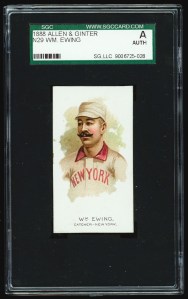
At the time I started, I was getting more into baseball caramel cards, so it was a slow start. But one of the first cards in the set that I got was also the biggest — the card of Baseball Hall of Famer Buck Ewing.
By comparison to the first series, which included ten baseball cards, the N29 second series had only six. Most, too, were not big names by today’s standards. Ewing is the biggest and the only Hall of Famer. I don’t recall where I got the Ewing, but it is a remarkably clean low-grade card with only a little bit of paper loss on the back. And given its rarity and one of Ewing’s few playing day cards, it’s always been undervalued to me. PSA has graded only 85 of his card while Cap Anson’s, star of the N28 set, has been slabbed 250 times.
With Ewing, I was off and running.
 Combat Sports, Anyone?
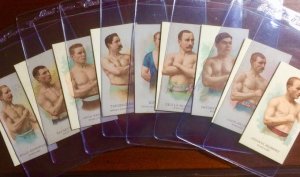
I’d made pretty decent progress in about a year’s time, with maybe about 15 of the 50 cards, or so. But the following fall, I got my first big break in landing all almost all of the boxing and wrestling cards.
I stumbled upon an auction for nine of the ten cards and, ironically, already had the tenth, fighter Frank Murphy. I was able to wrap up this subset containing the most cards in a very short amount of time.
The N28 boxing subset was much bigger, anchored by the likes of John Sullivan, Jack Dempsey, and Jake Kilrain. But as I mentioned earlier, with the N29 cards being rarer finds, wiping out almost 20% of the set all in one pickup was a big help. By the end of 2019, I was about halfway complete on the set.
Should be an easy one, right? Right?
My Favorite Card?
In 2020, The Year of the Covid, shall we say, I kept buying a little. But I was also focusing more on an assort of singles. Plus, my Allen & Ginter project was starting to fall in priority to some other projects I was working on, like the E90-1 American Caramel set I recently wrote about, as well as E91 American Caramel.
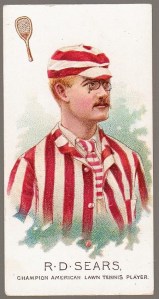
Still, I made a few buys that year, including what is probably my favorite non-baseball card in the set of tennis champion, Richard Sears.
Sears was a truly extraordinary tennis player. And as a bonus, the cards of tennis stars in the Allen & Ginter set, as well as the N162 Goodwin Champions set, are generally regarded as the first ones of real players. Sears was probably the first true American tennis star. He won the first seven US Open singles titles (1881-1887) and also proceeded to win six of the first seven doubles titles, too, with partners James Dwight (five titles, and who is also in this set) and Joseph Clark (one title).
But, of course the real reason I’m fascinated with this card is the not-at-all gaudy red and white striped jacket with matching hat and tie. Fantastic.
Little Progress, But What is C.W.V. Clarke Doing, Exactly
In the post-Covid aftermath, I was really busy chasing other things. I barely paid attention to building this N29 Allen & Ginter set, even though I was beyond the halfway point.
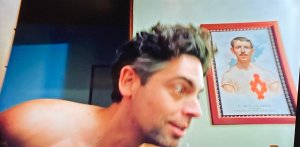
But in 2022, watching TV, a commercial flashed across the screen. After hitting reverse on my remote control, my fascination was confirmed — hanging on a bathroom wall was an oversized N29 card of a champion pedestrian, C.W.V. Clarke, whose claim to fame was walking three miles in 21 minutes.
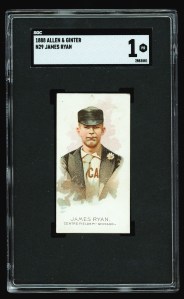
But no, that isn’t at all the point. The point is, why is a jumbo-sized trading card from more than 125 years ago hanging randomly in some guy’s bathroom? No clue, but there are other N29s that were similarly created and turned into posters, including one for baseball player James Ryan.
While that is unusual, the idea of putting using a picture of this card from a set that hardly anyone knows about was what I was really curious about. Was the director a card collector or did they simply pick up the first poster from a Bed, Bath, and Beyond? I wish I knew the answer.
 Getting Serious
My N29 Allen & Ginter project had started to really stall out. I made some progress in 2020-2022, but it was pretty minimal until Fall 2023 rolled around. By that time, I was really trying to get serious about finishing some sets I’d been working on for years.
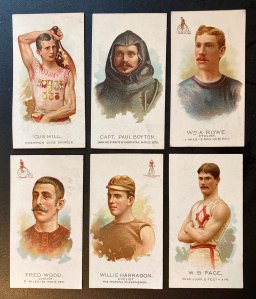
Last fall, I made a score of six that I needed. No big names in the group, really. But some, including the cycling cards of Rowe, Harradon, and Wood, have started selling for more money. And as I’ve said two other times now, the cards in the set are just really hard to find. I remember the Harradon being one that I’d sought for a while and it was the first example I found for sale (and then, of course, as is customary, I saw several others enter the market after that).
These six put me somewhere around 85% completion. The last ten cards or so that were needed were most of the baseball players as well as a handful of others that had eluded me to this point, including tennis star James Dwight, who I landed in January.
Doggie at the National
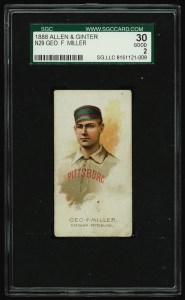 After that, I also got a big boost at the National, adding an SGC 2 of baseball player, George Miller.
George ‘Doggie’ Miller (not to be confused with George C. Miller, who played from 1877 through 1884) was spotted at a dealer table at the show. I hadn’t particularly spent that much to that point, so when I spotted this clean card at a mostly reasonable price point, I figured, why not?
Miller wasn’t a star player and, frankly, I’m not sure how he landed in the set with such a small baseball checklist. Part of Allen & Ginter’s ‘problem’ was that, with the exception of Theo Bauer (a wrestler), athletes were one and done, and not featured more than once. So, while the N28 first series was stacked with baseball stars, such as Cap Anson, King Kelly, John Clarkson, and more, N29 was left with mostly scraps.
Doggie Miller did it all. Some years, he was primarily a catcher and outfielder. Some years, he was primarily an infielder. And other years, like 1891, he did everything. That year, he caught 41 games, was a shortstop in 37 games, played at third in 34 games, and was in the outfield for 24 games. He also played more than 70 combined games at first and second. According to Wikipedia, too, he was the first player in the majors to play at least 20 games in all non-pitching positions on the field. The fact that he was a Swiss Army knife seems like his best trait. He was a career .267 hitter and, while a solid base stealer (260 career steals), he was not a particularly strong offensive player, save for a couple of random seasons.
I don’t know that I would have picked up the card of Miller if I wasn’t so close to the finish line as I was trying to buy other cards at the time. But the prospect of not finding another one anytime soon was starting to wear on me and was also a determining factor. In hindsight, I’m glad I did.
Alright, Fine. More Baseball.
After picking up Miller, I had half of the six baseball cards in the set. And six years into this project and with a bit of extra money, I was ready to wrap up.
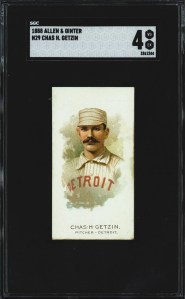
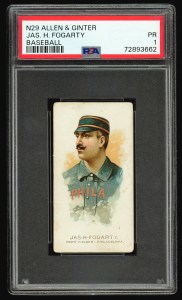
This summer, I picked up really nice examples of James Ryan and James Fogarty — two really gorgeous cards. And then, last month, I scooped up this way-too-gorgeous-for-me card of ‘Pretzels’ Getzien, clearly an outlier as an SGC 4 as opposed to the 1s and 2s I am accustomed to. And if you’re wondering, it’s my spelling of Getzien that’s correct — not the ‘Getzin’ on the uncorrected error card.
I paid more than I wanted to for these guys, honestly. But anyone that’s built a fairly tough set knows the same thing that I do — you either drag it out long enough to pay what you really want, or you eat some money on a few cards and get it done in a more reasonable time. I do wait on some cards but I had a goal to complete this set this year so, yeah.
Nevertheless, what I will say about this group is that, all of these guys present extremely well. Tough to complain here and it was nice to knock out the baseball subset this year.
 Completion
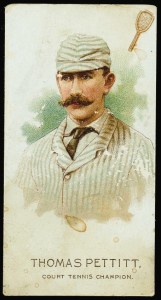
I fully expected a baseball player to be the last card I needed, but that wasn’t the case. Turns out Hall of Fame tennis player Tom Pettitt decided he’d take a while before finally showing up.
Other than a couple of really high-grade examples of Pettitt (one of which, a PSA 9, sold on eBay for $3,000, just to show the demand of the really early tennis stuff), I struggled to track one down. So when a raw example right in my wheelhouse showed up, I was more than ready to buy it.
Pettitt is not your traditional lawn tennis player. He played a sport called Court Tennis, as indicated by the card, which is called ‘Real Tennis’ in America. It is said to actually have preceded the more common lawn tennis. This sport is played indoors and there are few regulation-sized courts even available throughout the world.
Pettitt was better than the rest and deemed to be the world champion when this set was released. He later became a member of the International Tennis Hall of Fame.
This respectable card, not high-grade by any means, still sold for more than $100. That tells you just how much the tennis cards from the early champions sets are in demand. Folks recognizing that these are the first mainstream cards of actual players are starting to pay more for them. Some of the colorful Goodwin Champions tennis cards are selling for a few hundred dollars. They are not yet at the level of the baseball cards. And if I’m being honest, these are some of the few tennis cards where there’s actually interest. Other tennis stuff has not been drawing a ton of interest for the most part. But these 19th century Champions cards are getting more and more valuable.
Next Up
Next up is finishing the N28 Series that I started along with this one. And with only a few cards needed for that set, hopefully a celebratory post on that one will come sooner rather than later.
Want more talk about pre-war cards? Follow me on Twitter / X here.
 Pre-War Collector