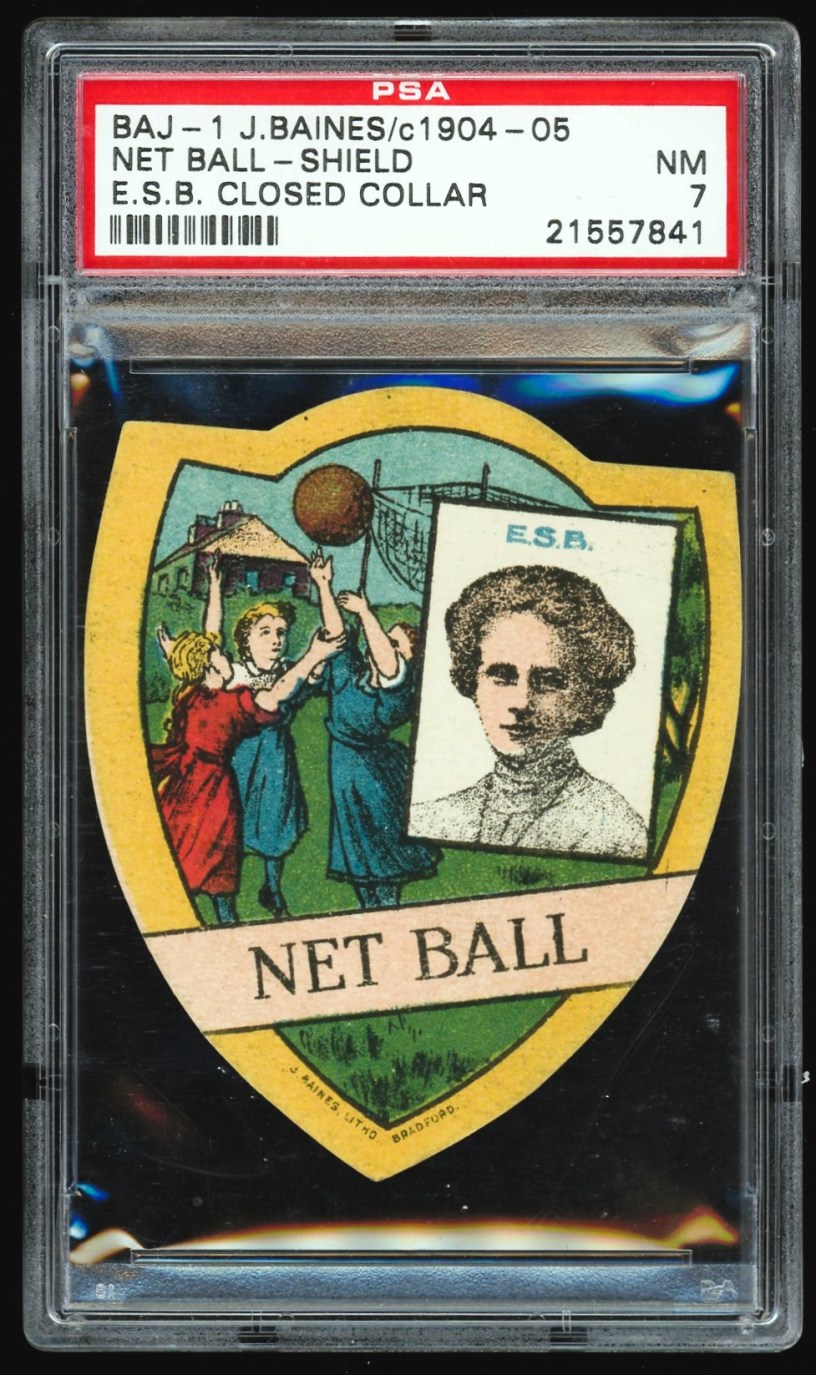
The Baines Shield cards from the UK aren’t too well-known by most American collectors. These were cards issued in the late 19th century and into the early part of the 20th century.
We could say that part of the reason for the lack of interest surrounding most of them is because of their international origins. But Americans have also quickly embraced other international issues if the topics are of importance, like the many Babe Ruth cards that have grown in popularity in the last decade (i.e. 1932 Sanella, Churchman Games and Sports, etc.).

Rarity could be another factor. These cards are a bit like the 19th century Old Judge baseball cards. The cards are not particularly hard to find one in general but finding a specific one can be a real challenge. Americans have also flocked to rare international issues in the past, like the Muratti Cigarettes Jesse Owens card, which has been his declared issue card for a while and is well-known.
No, the biggest reason the Baines Shield cards have not caught on much in America is largely because of the subject matter. The cards were the work of John Baines, a seller of toys who sold them. The key thing here is that, the majority of the cards featured cricketers and football (soccer and rugby). The majority, too, featured generic subjects or real teams as opposed to cards depicting actual players. Some of them did, and in those cases, the cards can be quite valuable. An early cricket card of legend W.G. Grace sold recently for more than $12,000. But most Baines Shield cards that you see today will not have a person named on them. The fact that they largely picture cricket and soccer cards is, to me, the primary reason for their lack of popularity in the U.S.
They are catching on a bit more, however. And, importantly, while cricket and soccer/rugby was the focus, there are some other Baines cards. Some are non-sports related and others portray the sport of golf, as well as a handful of minor sports. A few very rare ones even picture baseball, like this rare one featuring a Quebec baseball team that I managed to find.
But two that have always been quite popular feature the sport of basketball. Er, netball.
Now, I’d known about the Baines Netball cards for a while. I initially learned about them about a decade ago on the excellent website, Vintage Basketball. But finding one was another matter entirely.
The First Basketball Card?
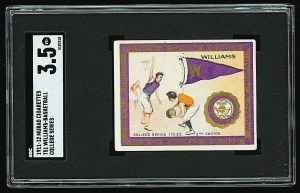
The cards are sometimes argued as the first cards depicting basketball. Often, it is pointed out that the cards depict netball, instead of basketball, though. And that is the primary reason that they haven’t been recognized as cards depicting the more popular sport. For my money, I do not consider them the first basketball cards. That title, as I wrote years ago, probably belongs to the T51 Murad Williams Basketball card.
The cards very clearly do depict netball and netball is a distinctly different sport than basketball today. But a bit of education on that subject is necessary here because the two sports are practically woven together.
Netball spun off from James Naismith’s basketball game and, at the time these cards were created, the two were almost identical. Six years after the sport of basketball was invented, an American teacher took its rules and made some modifications to it, playing it outdoors at a college in England (hence where Baines gets involved) and without backboards. The rules have further evolved a bit more but, at the time, it was essentially basketball just without the convenience of having a backboard.
When you add it all up, you get some collectors believing the comparison is close enough to consider it a basketball card and others referring to it as strictly a netball card. Whichever side of the fence you are on, one thing that cannot be denied is that the two sports were essentially the same at the time Baines put them on cardboard.
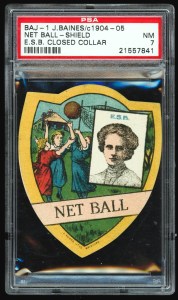
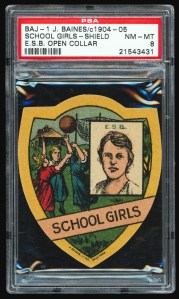
In either event, the cards have always intrigued me. And I say cards because there are a handful of different variations with minor differences. Primarily, though, there are two main variations. One includes a scene with girls playing the sport and a banner with the words “Net Ball” while a second uses the same netball picture but with a banner that reads, “School Girls.”
Acquiring the Cards
 I’d been looking for my opportunity to eventually purchase one of these cards but one never presented itself. I remember finding one on eBay years ago but missing the end date and seeing it slip through my fingers.
Earlier this year, though, a pretty good opportunity came my way.
A seller had listed one of the cards for sale on eBay. It was no ordinary card, though. It happened to be the highest-known graded example of the School Girls variation, a PSA 8. While the majority of my collection is lower-end pre-war stuff, I jumped at the chance to buy this high-grade example of a card that, quite easily, may never be surpassed. The cards are so rarely seen (PSA has graded only three in total with no other card graded higher than a PSA 3) that it would be quite possible that I would never have the chance to buy this one again.
As if that was not a big enough surprise, the same seller a few days later posted its counterpart — a PSA 7 of the ‘Net ball’ banner card. That one is one of only six graded by PSA, and, too, also the highest-graded example by a wide margin. The next highest-graded card is a PSA 4.
I do not know that the cards are quite as rare as made out to be for a few reasons. The majority of Baines Shield cards are not graded. Even that aforementioned, five-figure Grace card was sold as a raw example. The cards, too, are also sitting in collections in the UK and it is possible their popularity is not quite as well-known just yet. Still, I do believe the cards are very rare for two specific reasons. One, I’ve been looking high and low for them and have rarely encountered them. And, more importantly, most Baines Shield cards in general are quite difficult to come by.
Recent Sales
I’ve been tracking these cards for years and saw another one finally pop up since purchasing the two above.
An auction ended on eBay a few days ago that I’d been following closely. It was for a raw, lower-grade example. While you can never tell for sure, to me, the card had the appearance of a 2 or 2.5 if graded. It ended up selling for nearly $450 including the bid and shipping, which I felt was a healthy number for a lower-end raw example.
That is also a big growth over another sale from 2020 when a much cleaner PSA 3 sold for $350.
 Pre-War Collector