When it comes to the T206 set, in terms of rarity, the Big Four are unquestioned. There is little doubt that the shortprinted cards of Honus Wagner, Eddie Plank, Sherry Magee ‘Magie’ error, and the error of Joe Doyle are the biggest and most valuable cards.
The next two also are not in doubt and are sizable cards — the Polar Bear-backed shortprints of Bill O’Hara and Ray Demmitt, which were focused around team changes. Those cards have seen an uptick in value and, even in low-grade condition, command about $2,000-$3,000, generally. After that, the set kind of drops off a bit. But two other variations are notable and have increased in value, too — cards of Kid Elberfeld and Carl Lundgren.
Elberfeld and Lundgren, like many others, have more than one card in the set. And, as is the case with the shortprints of O’Hara and Demmitt, they have two more valuable ones that center around team changes.
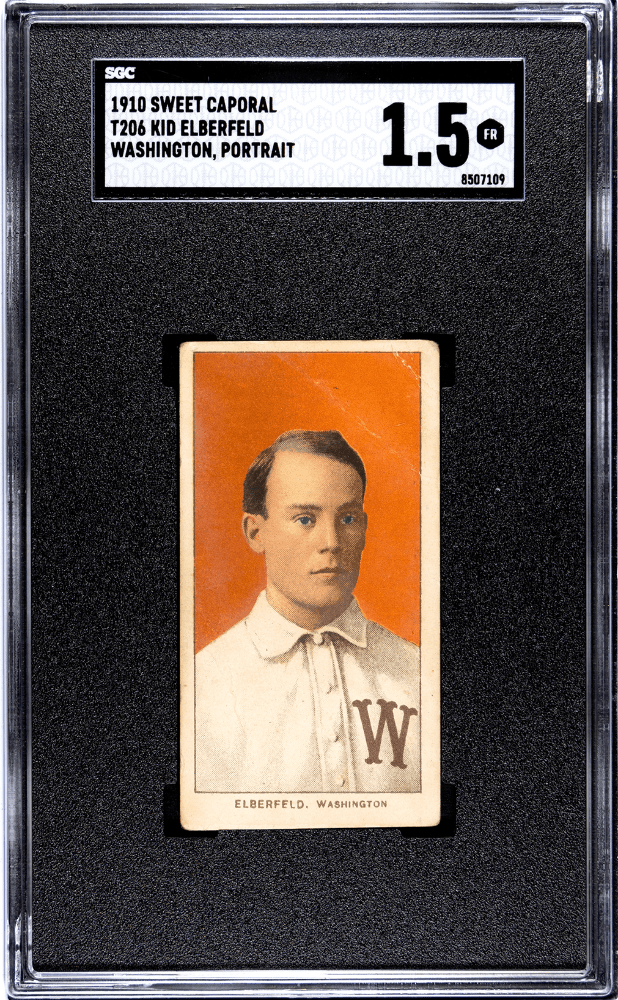
Kid Elberfeld’s Washington Portrait T206
 The two are somewhat comparable but Elberfeld’s seems to be selling for a bit more at the moment.
He has a less valuable portrait card for New York but this card would have been one changed after production went into effect as it notes his new Washington team. The two cards use the same image, but the New York on his jersey has been replaced by a large W.
The cards have a distinctive red background. However, like other red background cards in the set, it is often seen with an orange color instead. This is not a true variation — rather, it is almost certainly the product of the red ink simply running low in the printer. We know this because the cards are not simply seen with full red or full orange backgrounds. Many are shades somewhat in between.
Interestingly enough, Elberfeld’s third card is also for Washington. So it would have been printed after the New York portrait. However, it is not nearly as rare as his Washington portrait card. And while I haven’t delved into the back combinations of either card, it seems reasonable that the Washington portrait card would have been printed following his 1910 move to that club with the fielding Washington card of Elberfeld being printed in larger quantities after the fact. Based purely on the estimated population count of each card, the Washington example seems to have been a short-term replacement.
The populations, at least based on PSA’s records, seem to bear that out. Approximately 475 of the New York portrait card have been graded compared to about 325 of Elberfeld’s Washington portrait.
Some wonder why Elberfeld’s Washington fielding card does not garner more respect considering how valuable the portrait has become. But the simple reason is because it was almost certainly the card produced in the largest quantities. It is less valuable than both of those cards and still has been graded the most by PSA — as of the time of this article, exactly 600 times.
The price disparity between the portraits, however, is one that is somewhat difficult to come to grips with. While his New York portrait card does sell above the price of a standard T206 common, it is roughly 1/10 the value of his Washington portrait, which starts around $750-$1,000 in low-grade condition. Yet, the New York card, despite being much less valuable (and therefore, less likely to be graded), has only been graded about 30% more frequently. One might expect the Washington card to be much rarer to command that sort of premium. But for now, prices on it are quite high.
Carl Lundgren’s Cubs T206
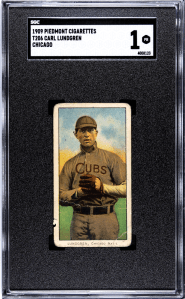 Lundgren’s expensive variation is also due to a team change.
In 1908, Lundgren’s pitching numbers took a dive. After never recording an ERA of 3.00, his ERA ballooned to 4.22 that season to go along with a 6-9 record for a team that won the World Series. Lundgren won a ring, but did not pitch in the series at all. In fact, he didn’t pitch in any of Chicago’s three championship appearances from 1906-1908. Despite his slide in 1908, he rejoined the team in 1909 again, the year the T206 cards were first distributed. But his stay wasn’t a long one. After only two appearances and 4 1/3 innings, he was let go.
That easily explains why his Cubs card exists in such short numbers. Had Lundgren stuck around until even just the end of the season, chances are his card would not have been a shortprint at all. Instead, it was likely pulled very early in production since he was no longer with the team.
Lundgren would resurface, though. He would later get a card for Kansas City of the American Association after that with only a slight background change. Only problem is, he never actually played for that club. After going to Toronto, he would be sold to the Kansas City Blues, according to SABR’s biography of the pitcher, but he never reported to the team. Despite that, he was given a card in the massive set for a team he never played with.
But while the population reports show the rarity of Elberfeld’s portrait card, they are less clear about Lundgren’s expensive Cubs variant. While about 350 of his Kansas City cards have been graded to date, his rarer Cubs card has been graded by PSA even more with about 380 slabbed.
Part of that can be explained by the fact that the card is more valuable. More of them, certainly, are graded because, even in low-grade condition, the card starts around $500. But for those wondering if it’s truly a rare card, eBay helps provide some backup. At the time of this article, roughly twice as many of Lundgren’s Kansas City cards were available on the marketplace than his truly rarer Cubs variant. And similar to the Elberfeld situation, Lundgren’s Kansas City cards are roughly 1/10 the price of the Cubs cards, with low-grade raw examples starting around $50.
Want more talk about pre-war cards? Follow me on Twitter / X here.
 Pre-War Collector