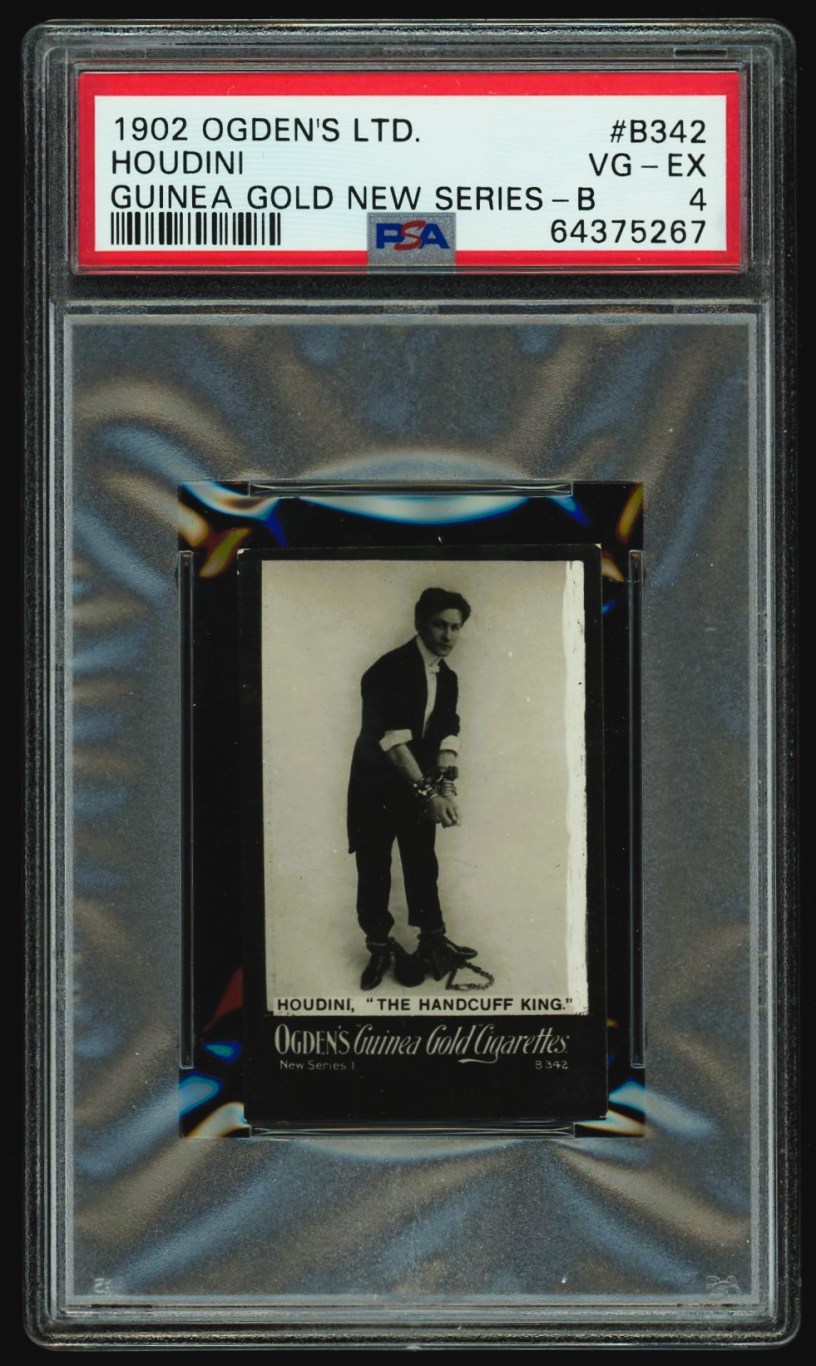
Legendary escape artist Harry Houdini isn’t found on nearly as many cards as is probably deserved. At his height, he was likely one of the most popular figures on the planet as he performed his famous escapes not only in the United States, but around the world.
Other famous subjects were certainly depicted on all sorts of trading cards dating back to the 19th century. But while Houdini’s popularity in the early 20th century coincided with the growth of American tobacco cards, you won’t see him featured in many sets at all. To my knowledge, he is only found in about a half dozen sets in all up to his 1926 death. Houdini’s 1922 Boys’ Cinema card is even sometimes touted as his first by sellers that either don’t know any better or are trying to capitalize on a sale. That card, is actually his last mainstream appearance on a trading card.
The reason for Houdini’s lack of trading card appearances is unclear as celebrities were pictured in all sorts of non-sports sets. But, as we see in the case with baseball player Shoeless Joe Jackson, that dearth of cards from his era has meant that collectors are willing to pay more to get their hands on them.
While Houdini has some later known from the 1910s and 1920s, his most famous issue comes from Ogden’s Guinea Gold Cigarettes out of the UK.
About the Ogden’s Cards
Ogden’s Guinea Gold cards shared quite a bit in common with the popular cards Ogden’s developed from their Tabs cigarettes from around the same time. The two sets even shared some identical images and subjects. Both, too, were black bordered cards and the images were mostly black and white (some of the Guinea Gold cards of actresses did include a bit of color). But the two types of Ogden’s include plenty of differences, too.
The physical makeup of the cards is different. Tabs cards have a matte surface, different font style, and are generally more rectangular cards as opposed to the glossy Guinea Gold issues, which vary quite a bit in sizing. The glossy surface on the Guinea Gold cards certainly gives them a bit of an ‘upscale’ appearance.
The contents of the sets are also not entirely uniform, either. While both certainly contain a certain hodgepodge of subjects (including few sports), the Guinea Gold cards tend to focus more on famous subjects with numerous actresses, in particular. Tabs cards, particularly the massive 1,560-card General Interest series from 1901 and 1902, also have plenty of famous subjects but there is much more focus on, well, everything. Collectors will find all sorts of things in the Tabs issues, including a significant focus on animals, buildings, scenery, and a lot more, including the style of life and cultures at the turn of the century.
Houdini’s Card
 Ogden’s card of Houdini provides a great image of the escape artist. On the front, Houdini is handcuffed and posing for the picture.
The card itself is from Guinea Gold’s New Series B set. Like the Tabs’ General Interest series, Guinea Gold cards were separated into these sorts of subsets upon being released. New Series B was followed by New Series C. There were also Base series’ D, E, F … down the line to at least M. Dates of all of these cards have typically been credited as being issued from around 1900 to 1902. We’ll talk a little more about the dating in a minute, though.
Back to this blank-backed card of Houdini. The card is one of the most valuable Ogden’s Guinea Gold or Tabs cards out there. And while I concede that, given the scope of those cards and that they are infinitely more popular abroad than here, a more valuable one may exist, I am not aware of a definitive one.
The rookie card of soccer (fine, football) legend Billy Meredith may be closest. That card is found in one of the non-Guinea Gold Ogden’s sets and it rivals this one in terms of value. A low-grade Meredith sold for about $400 earlier this year. However, simply put, the Houdini card is one of the most popular and most valuable of the more than 10,000 Ogden’s Tabs and Guinea Gold cards that were issued. Low-grade examples of Houdini’s card typically start around $500-$1,000 and anything half-decent will usually run over $1,000. High-grade examples are significantly more. Heritage sold a PSA 7 earlier this summer for more than $5,6o0.
Keep in mind, the cards are very hard to find. To date, PSA and SGC have combined to grade only a little more than 30 Houdini cards in all with PSA grading the majority of those. One of those is this PSA 4 example I purchased earlier this year, shown here.
Finally, it should be noted that, cigarette and tobacco cards that printed their names at the bottom are sometimes found with those advertisement portions cut off. Ogden’s Cigarette cards sometimes suffered that fate, too. Thus, you will occasionally see Houdini cards with the Guinea Gold Cigarettes portion removed, making for a less presentable (and less valuable) card.
The picture is a famous photograph of Houdini that looks much like a publicity photo. Ironically, it is the image that helps to muddy the date of it was printed and ultimately prove that the year assumed by grading companies may not be the correct one.
Dating Mystery
Houdini’s Guinea Gold card is generally dated as a 1902 issue but that seems incorrect. That’s because the picture is dated in several online sources, including this one, as a photograph from 1905.
It should be noted that, even that date may be incorrect. Dates on old photographs are often all over the place. This page, even from the same site, Alamy, says is it is an 1873 image. That, of course, is impossible — Houdini was not even born until 1874. Yet another Alamy page declares the image to be from 1913. Britannica’s website calls is a c1905 picture. Finally, taken from the Library of Congress (as is also cited on Brittanica’s website), Getty Images says it is a 1905 image, too.
When in doubt, go to the experts. And this site, which focuses on Houdini, has some information, too. That site is certain the card is not a 1902 issue as well, citing that the image was not taken until 1904. A final note to the dating is this post from the Vintage Non-Sports site, which states that New Series 1 cards (of which the B Series is part of) should be dated to 1904-07.
So if the card was not issued in 1902, why do the grading companies state that it is? That is probably because the London Cigarette Card Company’s Cigarette and Trade Card Catalogue (at least my 2015 version of it) states that the ‘B’ series, of which this Houdini card is from, is a c1902 issue. However, the Houdini site linked above states that the set was actually printed over several years until 1907. And c1902, really, could mean it was issued several years before or after, anyway.
Given that I’ve found no credible reference to the image on Houdini’s card being printed earlier than 1904, it does not seem likely that this card is from 1902.
For fans of it, however, that makes little difference. Premiums are placed on the first cards of a subject and, even if this card was printed a few years later, it is still believed to be the first mainstream card of him (earlier cabinet cards with mounted photographs do exist). And, with a nod to its rarity, it is easy to see why it is in demand.
Want more talk about pre-war cards? Follow me on Twitter / X here.
 Pre-War Collector