 At this year’s National Sports Card Convention, I was able to complete a seven-year project in the E91 American Caramel series. Some collectors have built one of the three 33-card sets (known as E91A, E91B, and E91C). However, I’d slowly been working towards the goal of assembling all three. The 99-card quest came to an end as I recently wrote about acquiring the Mordecai Brown card in the 1909 E91B edition.
Those sets are not as widely collected as other caramel cards. But another caramel card pursuit of mine is one of the most popular of that type — the 1909-11 E90-1 American Caramel set.
T206 is dubbed as ‘The Monster’ and king of all tobacco sets. E90-1 might as well be named the same not only for its size but also the rarity of numerous tough-to-find shortprints. With 121 recognized cards, it’s one of the biggest caramel card issues. I’d estimate that about 40 of those are more difficult cards to find to varying degrees. And about 15-20 of those can be deemed as flat out tough. Many of the really tough ones rarely even appear for sale on eBay and when they do, asking prices are often quite high.
T206 is a difficult set build mostly because of its large size. E90-1 has that same issue in comparison to other caramel cards but, aside from T206’s Big Four, which are rarely pursued, it has a much larger number of hard-to-find cards as well. Those two factors make completing a set nearly impossible.
 Without the valuable Shoeless Joe Jackson rookie card, I’m technically sitting at 120 of the 121 cards. Sure, I may land one of those someday. In fact, I’d even consider it a minor goal. But for now, I’m considering this the end of the road on this set build for me. And getting to this point was a long road in itself — particularly since prices on the set have spiked considerably.
Technically, I’ve tried to complete this set on two occasions. The first was about ten years ago. I’d consider the set to be collectible in three separate chunks. The first chunk consists of roughly 40 cards. None of the cards, technically, are all that common. But if building the set, getting the first 40 cards out of the way isn’t too hard to do. You won’t find those cards in bunches but there are about 40, perhaps a bit more, where you’ll be able to find at least a few copies on eBay, pretty easily — even if those prices are a bit inflated.
After that, you’ve got another 40 that are tougher. Tougher, but not impossible. Then you’ve got the final 40 that I’d consider to be the challenging ones.
The first time I tried building this set about 10 years ago or so, I accumulated just under half of the set. But it wasn’t a real priority at the time and my T205, T206, and T207 set build was really what I wanted to focus on. I don’t like giving up on projects but E90-1 was an easy one to pass on just because I really had none of the key cards.
Around 2016, I restarted the project.
The Restart
 I remember only slowly picking my way through the set at first. It took about two years for me to reach nearly the halfway point, even though almost all of the cards I’d secured to that point were pretty easy ones. As a point of comparison, I was able to to build my 520-card T206 set in about nine months and T205 in about a year. Those cards were more numerous but generally much easier to find. And I still wasn’t really sold on E90-1 being something I was all that passionate about.
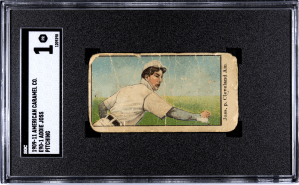
Many people love the set, and rightfully so. I can say that I do now, but it took some time to get to this point. Unlike the more common tobacco cards, many of the images in the E90-1 set, frankly, are not all that great. Some are quite good but it is easy to find several, like this shortprinted Addie Joss horizontal card, for instance, that leave a lot to be desired.
The beauty for me, as I would learn, is more in the rarity of the set.
And notably, Joss’ portrait card was the one that officially moved me beyond the halfway point in the set. Once I got to that stage, I started to get more interested.
 Pushing to 2/3 Complete
While it took me about two years to acquire the first 60 cards, the pace slowed a bit, despite my newfound interest in the set. I finished 2018 with another 20 cards.
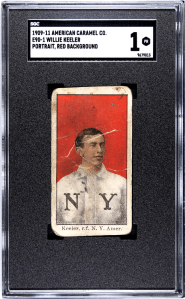
That was another important milestone and, importantly, I started adding some of the tougher cards. Willie Keeler’s red portrait, one of his three variations, was probably the notable one I grabbed that year.
Keeler’s was probably the biggest rarity that I picked up that year. But over that time I was also able to add some tougher cards of common players, such as Orval Overall, George Gibson (front), Mike Donlin, Art Fromme, and Ray Demmitt.
Aside from Overall, who is usually regarded as a pretty tough card, the others are all not too bad. Still, by the end of 2018, I was farther than I’d ever been on the set and, sitting at 2/3 complete, I was pretty motivated to continue on.
Targeting 100
 I set a tentative goal to try to reach 100 cards by the end of 2019. That would have not only meant picking up another 20 cards for the second consecutive year, but also that I’d acquired some rarer ones.
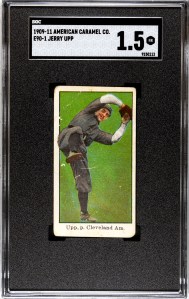
Things were looking pretty good to hit that target. And, yep, I did grab some of the rarities that year as well. In addition to Keeler’s throwing card, I also added the shortprinted card of Hall of Famer Hugh Duffy. Another big shortprint that’s a real bear is the fantastic looking card of pitcher Jerry Upp (shown above). Along with Duffy, another big rarity in the group that I managed to find was the tough card of Peaches Graham.
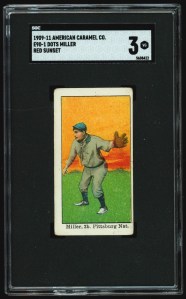
The biggest rarity of them all, though, might be the sunset variation of Dots Miller. Here’s the backstory on that card, but it was one that I managed to pick up in a trade.
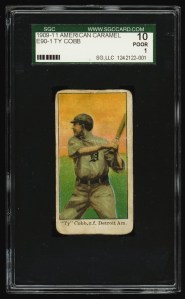
It wasn’t just about the shortprints, though. I started to key in on some Hall of Famers, too. Low-grade examples of Eddie Plank, Sam Crawford, Rube Marquard, George Davis, Vic Willis, and Nap Lajoie were five that I managed to pick up. But I saved the biggest one for last, winning this Ty Cobb in an REA auction right at the end of the year.
At the end of 2019, it was game on. I fell just short of my 100-card goal, reaching the painstaking number of 99. But I had added enough rarities and Hall of Famers that made it feel like completion was very real. In terms of key shortprints and number of Hall of Famers, 2019 might have been the biggest year in terms of building the set.
 Covid Slowdown
Despite the Covid pandemic, 2020 began with a hot start for me. I was laid off early in the year but in little mood to slow down on my latest project.
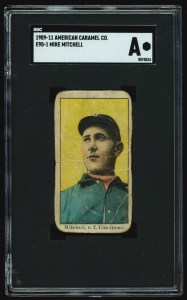
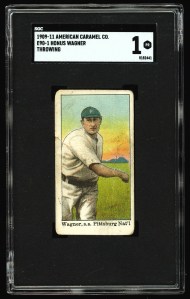
Early in the year, I picked up the shortprinted Mike Mitchell, which had been one of those sort of iconic rarities heavily sought after in the set. I also added Frank Chance, Christy Mathewson, and Home Run Baker. The biggest pickup to date, though, would come in April, when I landed the ultra rare throwing variation of Honus Wagner. While it was a notable card then, the value of Wagner cards skyrocketed soon after. Since then, it’s been nearly impossible to find, and I was glad to pick up this example of a solid SGC 1.
I was able to add a couple of other cards, including the rarer corrected Pittsburgh variation of Fred Clarke’s card, but that would be it. Despite my interest, it was getting harder and harder to find the cards I needed. In all, I’d picked up only seven cards that year. But given the rarity and value of some, looking back, it was a pretty productive year.
It’s … Progress?
 Down to mostly tougher cards, I hit an undeniable wall in 2021.
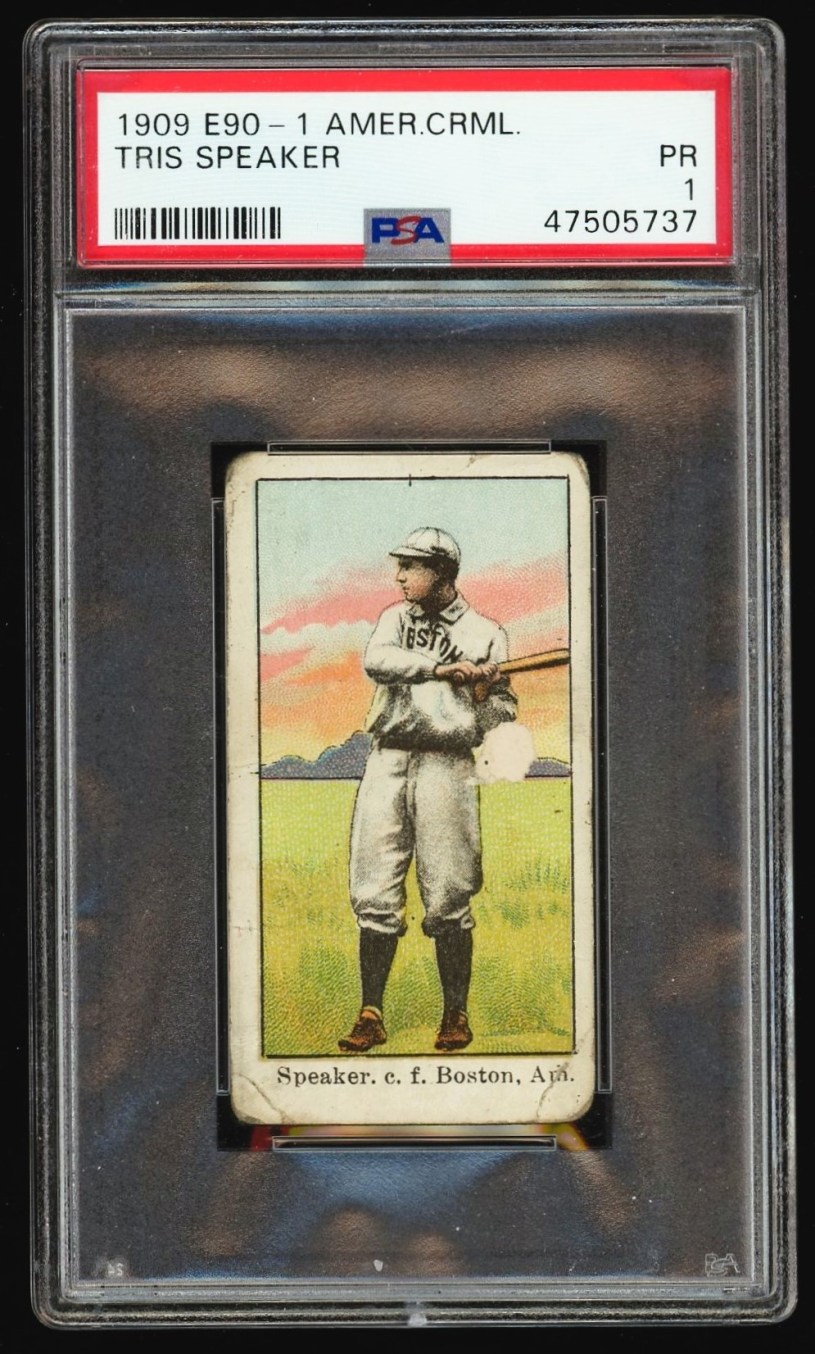
Things started off fast with two of the rarer big-name cards added — Cy Young’s Cleveland card and the insanely tough Tris Speaker. After the Shoeless Joe and Honus Wagner cards, Speaker’s has been the most valuable in the set by a wide margin with low-grade examples now usually selling for more than $5,000. Another big rarity pickup was the shortprinted card of Hall of Famer Ed Walsh.
Unfortunately, those three cards, along with a handful of remaining non-shortprints I needed, would be the only progress I made in terms of newer cards. But a big win of a caramel card lot would be another nice find. It didn’t yield any new cards. But it did provide several upgrades, including what would be graded an SGC 3 of the rare Dots Miller sunset variation.
A productive year? Sort of. But I was also left a bit frustrated since it was again the fewest total cards (seven) I’d picked up since working on the set.
As an aside, though, I managed to quickly build a supplemental E90-3 American Caramel series, a 20-card set of only Chicago players. It includes the major league rookie card of Chick Gandil, he of Black Sox infamy, so the year wasn’t a total loss.
 Hitting a Wall
I was much too far along to take a break from building the set but 2022 was by far the most frustrating.
By that point, I was watching along closely for cards I needed. I’d long since been monitoring eBay but was now scouring auction house listings more and even Googling specific cards to see if they would pop up for sale by card dealers with an online presence.
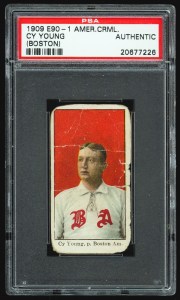
Nothing all year, until November when I managed to land Cy Young’s other E90-1 card, his Boston portrait, from a Facebook group.
The Young has significant back damage but, hey, at this point, you take what you can get. It’s a card you see in low-grade starting around $2,000 these days so I’ve got little motivation or interest in upgrading it.
The End
2023 went much better. It wasn’t so much that I saw cards I hadn’t see before. It was more about the fact that I simply had to spend more than I wanted to get them.
The lone exception to that was lucking out on a shortprint of Bill Sweeney. Traditionally, the two really tough commons in the set had been viewed as the aforementioned Mitchell and Sweeney.
 My preference is always to pick up low-grade examples of the bigger cards in a set. But with E90-1, that doesn’t always happen because, other collectors building the entire set will often take that same approach. That often leads to more demand for those sorts of cards than the pricier expensive ones that few can afford. I really lucked out with this Authentic-grade Sweeney, however, won from a Heritage Auction, if I recall.
Also in 2023, I grabbed shortprints of George Stone (one hand showing) and Dave Shean. Stone was a bit of an overpay and while Shean wasn’t necessarily, it was still more than I wanted to pay for a very low-grade card.
I sat at 118 for several months and finally landed the tough card of Jake Stahl. While Sweeney and Mitchell are the two historic commons most talked about, Stahl’s card has certainly caught up with them, and clearly surpassed Sweeney. A nicer low-grade example topped $2,000 this year and when I had the chance to grab a decent one for less, I jumped on it.
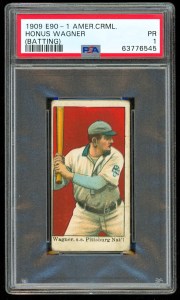
The final card in my pursuit was Honus Wagner’s batting card. Technically, the throwing card is rarer. But I’d seen a grand total of one for sale in the last couple of years, with the most recent, an SGC 1 with major paper loss in 2023, selling for a little over $8,000 that I expected to go for half that amount. This year, I got another shot at a Wagner and didn’t hesitate.
I think when I first started this project, I hoped to have it done within maybe four years. But things got complicated as card prices soared right in the middle of it. And while Shoeless Joe may not be on my radar for now, who knows?
Want more talk about pre-war cards? Follow me on Twitter / X here.
 Pre-War Collector
Comments are closed.